Investigation Report by the World Organization to Investigate the Persecution of Falun Gong (WOIPFG) on the Core Role of the European and American Alumni Association in Overseas Infiltration and United Front Work


For a long time, successive leaders of the CCP have continued to attach great importance to the work on overseas students and the development of the European and American Alumni Association. The European and American Alumni Association has also long received direct attention and support from the highest level of the CCP. As early as 1995, the CCP clearly included overseas students and returnees into the united front work system, making the work on overseas students an important part of the united front work. As one of the core functional departments of the CCP’s united front work, the United Front Work Department of the CCP Central Committee plays a key role in the external united front work and overseas penetration. Its work scope covers the guidance and integration of organizations of overseas Chinese and overseas Chinese students.
In 2003, the Association of Returned Scholars from Europe and America (ARSEA) added the name "Chinese Overseas Students Association," further institutionalizing and clarifying its political attributes and functional positioning. Since the 18th National Congress of the Chinese Communist Party, the CCP Central Committee with Xi Jinping at its core has given the ARSEA higher-level attention and promotion. In 2013, Xi Jinping delivered a speech at the ARSEA 's 100th anniversary celebration, systematically affirming the ARSEA's historical position and role in the "so-called" process of China's revolution, construction, and reform, and explicitly establishing this speech as an important guiding principle for the ARSEA's work and functions.
In terms of organizational development and overseas layout, in 2014, relying on the overseas returnee groups with certain influence and resources, the ARSEA successively established overseas liaison work stations in seven countries, including Japan, Singapore, Sweden, the United Kingdom, Ireland, the United States and Canada, so that its overseas work had a relatively fixed organizational support. In 2015, the ARSEA further proposed to accelerate the development of overseas work stations, appoint more overseas directors, and gradually build an overseas network system with wider coverage and closer connections[1].
On May 12, 2016, the General Office of the CCP Central Committee issued the Opinions on Strengthening the Construction of the Association of Returned Scholars from Europe and America (Overseas Students Association), which clearly positioned the ARSEA as a "new focus of united front work" and further strengthened its institutional status in united front work. On October 21, 2023, Xi Jinping sent a congratulatory letter to the ARSEA on its 110th anniversary, and once again clearly proposed the development direction of building the ARSEA into a talent pool for overseas students to serve China, a think tank for offering advice and suggestions, and a vital force for people-to-people diplomacy, providing clear political guidance for its continued service to the CCP's relevant united front strategies in the new stage [2].
Against this backdrop, the ARSEA prioritizes "ideological and political guidance" in all its work, emphasizing the in-depth study and implementation of the spirit of Xi Jinping's important speeches, and requiring its organizations and members to maintain a high degree of consistency with the CCP in political stance and action. At the same time, the ARSEA positions the group of overseas students as an important force serving the CCP's national development strategy, united front work, and foreign exchanges. Its branches at all levels have gradually and effectively become constituent units with clear political functions and organizational attributes within the CCP's united front system.
Ⅰ. Introduction to the Association of Returned Scholars from Europe and America (ARSEA)
The Association of Returned Scholars from Europe and America/Chinese Overseas Students Association (hereinafter referred to as the ARSEA) is a mass organization voluntarily formed by Chinese students who have returned from studying abroad. It is led by the Secretariat of the CCP Central Committee and managed by the United Front Work Department of the CCP Central Committee. The ARSEA was jointly initiated in October 1913 by Gu Weijun, Liang Dunyan, Zhan Tianyou, Cai Yuanpei, Yan Huiqing, Wang Zhengting, Zhou Yichun and others. It was established in Beijing by returned students from overseas in Beijing and Tianjin. It has always adhered to the tenet of "studying, playing, building friendship and encouraging practice", inheriting the patriotic spirit of studying abroad to serve the country, uniting overseas students at home and abroad, and using advanced scientific and cultural knowledge and progressive ideas from abroad to contribute to the prosperity of the country and the rejuvenation of the nation.[3]
The ARSEA is currently under the leadership of the Secretariat of the CCP Central Committee and managed by the United Front Work Department of the CCP Central Committee. It is a mass organization led by the Communist Party of China, mainly composed of returned overseas students, and serves as a bridge and link between the Party and the vast number of overseas students.[4]
In 2003, the name "China Overseas Students Association" was added to the association's name[5]. The ARSEA actively implemented the requirements put forward by the CCP to "strive to become a bridge and link between the Party and the vast number of overseas students, to become an assistant to the Party and the government in doing a good job in the work on overseas students, and to become a home for overseas students". It focused on strengthening ideological construction, organizational construction, cultural construction and the construction of a home for members. It gave full play to its talent and intellectual advantages, established a base for studying abroad to serve China, offered advice and suggestions to the CCP and the government, and did a good job in serving high-level overseas talents. Its social influence gradually expanded.
As of 2023, the ARSEA had 42 local organizations, 2 member groups, and 15 national and regional branches. It currently has 125 standing directors, 287 directors, and 35 overseas directors [6]. As of 2024, the ARSEA's national organizational system has been further improved, with more than 1,400 ARSEA related organizations established, including 31 provincial (autonomous region, municipality) and Xinjiang Production and Construction Corps ARSEAs, 15 sub-provincial city ARSEAs, 240 prefecture (city, autonomous prefecture, league) ARSEAs, and more than 670 higher education institutions and research institutes ARSEAs. There are approximately 340,000 individual members [7].
The Association of Returned Scholars from Europe and America has a board of directors, a standing board of directors and a board of branch presidents. The board of directors is the highest authority. It consists of 17 branches in the United States, the Soviet Union, the United Kingdom, Germany and Austria, France, Italy, Canada, Switzerland, Eastern Europe, Northern Europe, Latin America, Japan, Australia and New Zealand, Korea, Southeast Asia and South Asia; 28 group member units and nearly 100 alumni associations; 7 special working committees in the fields of organization, publicity, liaison, advice and suggestions, group membership, social services and membership activities; MBA Association, Entrepreneur Association, Business People Committee, Hotel Industry Expert Committee, and has established working contacts with more than 100 overseas student groups in Chinese overseas students concentrated countries, such as the United States, Britain, Germany, Japan, and Australia [8].[9].
Ⅱ. The United Front Work Department of the CCP, the ARSEA’s superior leadership, is one of the main institutions through which the CPC promotes the policy of persecuting Falun Gong overseas.
The United Front Work Department of the CPC is one of the main institutions through which the CCP promotes the policy of persecuting Falun Gong overseas. Through collusion with the Ministry of Foreign Affairs, the Overseas Chinese Affairs Office, and the State Administration for Religious Affairs, it manipulates overseas Chinese and Chinese students who have emigrated overseas to persecute overseas Chinese groups that have been targeted by the CCP. At the same time, it frequently operates among mainstream societies and political figures in various countries, attempting to "establish and develop a political alliance with the CCP as the core of leadership" in the world. Around the strategy of "the CCP's global united front", it coordinates internal and external efforts, creates public opinion, and attempts to subtly influence the decision-making of the countries in which it operates, in an attempt to enhance the influence and control of the CCP regime over the world.[10]
On July 1, 2021, CCP leader Xi Jinping said: “The patriotic united front is an important magic weapon for the CCP to unite all Chinese sons and daughters at home and abroad to realize the great rejuvenation of the Chinese nation.”[11]The CCP leader encouraged Chinese people around the world to unite and spread positive information about the rule of the Communist Party.[12]
The CCP uses state resources to tightly control overseas Chinese and students, making them serve the CCP's global strategy. The scale and depth are unprecedented in history. The CCP's infiltration poses a threat and harm to both the target countries and the Chinese residents living there. Examples include the "May 17th Flushing, New York Incident" in 2008; the CCP's instigation in July 2014 of unsuspecting Chinese people wearing red vests distributing materials attacking Falun Gong and inciting hatred near the Main Street subway station in Flushing, New York; the violent attacks on Falun Gong practitioners by the Taiwan "Patriotic Alliance" under the control of the United Front Work Department; and attacks on Falun Gong truth-clarification sites by the Hong Kong Youth Care Association (HKYCA), a branch of the CCP's "610 Office" in Hong Kong. Furthermore, the violent beatings and attacks on Falun Gong practitioners by members of CCP-organized "welcoming groups" or consulate officials during visits by high-ranking CCP officials are typical examples of the CCP's United Front Work Department's implementation of its persecution policy.
Ⅲ. The CCP top leaders and the United Front Work Department of the CCP provide leadership and attach importance to the ARSEA.
For a long time, successive CCP top leaders have attached great importance to the work on overseas students and the development of the ARSEA, which has always been supported by the CCP leaders.
The CCP Central Committee has always attached great importance to and cared about the overseas students and the ARSEA. The CCP leader Mao Zedong once delivered an important speech at Moscow University entitled “Hope is placed on you”. Zhou Enlai attended the ARSEA’s activities many times. In 1987, Deng Xiaoping wrote an inscription for the journal of the ARSEA. In 1993, Jiang Zemin attended the celebration of the 80th anniversary of the founding of the ARSEA and delivered an important speech. In 2003, Hu Jintao attended the celebration of the 90th anniversary of the founding of the ARSEA and delivered an important speech.[13]
In October 1993, Jiang Zemin attended the 80th anniversary celebration of the ARSEA and delivered a speech, urging the association to further strengthen its ties with returned overseas students, care about their work and lives, consider their suggestions and demands, and continue to play its role as a bridge and link.
In September 1995, the Central Staffing Office issued a plan outlining the organizational structure and staffing of the ARSEA, making it clear that the association was a mass organization under the leadership of the Secretariat of the CCP Central Committee and managed by the United Front Work Department of the CCP Central Committee.
In September 2003, with the approval of the CCP Central Committee, the ARSEA added the title "Chinese Overseas Students Association," further broadening its scope of work.
On October 8, 2003, Hu Jintao attended the 90th anniversary celebration of the ARSEA and delivered a speech, emphasizing that overseas students should closely link their future and destiny with that of the CCP and the country, keep pace with the times, study diligently, serve the country, make contributions, caring about and loving the country, and actively contribute their wisdom and strength to building a moderately prosperous society in all respects.
Since 2012, the United Front Work Department of the CCP Central Committee has supported the ARSEA in jointly hosting annual meetings and overseas returnee innovation and entrepreneurship summits with local Party committees and governments in Tianjin, Nanjing, Hubei, Guizhou, Sichuan, and Henan. Sun Chunlan, a member of the Political Bureau of the CCP Central Committee and then Minister of the United Front Work Department, attended and addressed the fifth annual meeting held in Chengdu, Sichuan in October 2016.
On October 21, 2013, Xi Jinping, top leader of the Communist Party of China, attended the centenary celebration of the ARSEA and delivered an important speech. He fully affirmed the significant historical contributions of overseas students and proposed a new policy for their work in the new era: supporting their studying abroad, encouraging their return to China, allowing them freedom of movement, and enabling them to play their roles. He expressed his hope that returned students would keep their feet firmly on the ground of their motherland, embrace the expectations of the people, and write a magnificent chapter worthy of the times, the people, and history in realizing the Chinese Dream of the great rejuvenation of the Chinese nation.
In March 2014, the first meeting of the seventh council of the ARSEA was held in Beijing. The meeting elected a new council. Chen Zhu, Vice Chairman of the Standing Committee of the National People's Congress, was elected president of the seventh council, and Professor Li Xiaoxin, director of the Peking University Eye Center and director of the Department of Ophthalmology at Peking University People's Hospital, along with others for a total of 24 people, were elected vice presidents.
During the meeting, Yu Zhengsheng, member of the Standing Committee of the Political Bureau of the CCP Central Committee and Chairman of the National Committee of the Chinese People's Political Consultative Conference (CPPCC), met with all the council members attending the meeting and held a discussion with the new leadership team. Ling Jihua, Vice Chairman of the CPPCC National Committee and Minister of the United Front Work Department of the CCP Central Committee, attended the meeting and delivered an important speech. Han Qide, Vice Chairman of the CPPCC National Committee and President of the Sixth Council of the ARSEA, delivered a work report.[14]
In May 2016, the General Office of the CCP Central Committee issued a document on strengthening the construction of the ARSEA/Chinese Overseas Students Association and issued a notice requiring all regions and departments to earnestly implement it in light of their actual conditions. By the end of 2018, the provincial-level organizations of the ARSEA/Overseas Students Association) had all but achieved full coverage, and the sub-provincial-level organizations had achieved full coverage.
In May 2016, Chen Zhu, Vice Chairman of the Standing Committee of the National People's Congress and President of the ARSEA, and former French Prime Minister Jean-Pierre Raffarin jointly launched the "China-France Cultural Forum," focusing on the "Belt and Road" initiative. Three forums were successfully held in Beijing, Lyon, and Xi'an. Xi Jinping, top leader of the Communist Party of China, sent a congratulatory letter to the first forum, expressing his hope that the China-France Cultural Forum would become an important platform for promoting mutual understanding between the people of China and France, learning from each other's cultural strengths, and jointly writing a new chapter in China-France cultural exchange and cooperation. The forum was incorporated into the China-France High-Level People-to-People Exchange Mechanism.
On July 6, 2016, the second quarterly symposium of the "Returnees Quarterly Talk" jointly organized by the ARSEA/Overseas Students Association and the Information Center of the United Front Work Department of the CCP Central Committee was held at the ARSEA.[15]Zheng Chuanfang, Vice President of the ARSEA/Overseas Students Association), Zhang Xuejun, member of the Party Group and Secretary-General, Zheng Zhicheng, Vice President of the ARSEA of Heilongjiang Province, Yu Bing, Vice President of the ARSEA of Shanghai, Xia Huaxiang, Vice President of the ARSEA of Sichuan Province, Lu Peng, Secretary-General of the ARSEA of Liaoning Province, and Xu Suining, Deputy Secretary-General of the ARSEA attended the meeting and delivered speeches. Zhang Mingjie, Deputy Secretary-General of ARSEA presided over the meeting.
In December 2017, the United Front Work Department of the CCP Central Committee issued a reform plan for the ARSEA/China Overseas Students Association. Focusing on enhancing its "political nature, progressiveness, and mass character," the plan aimed to promote organizational innovation, mechanism innovation, work innovation, and platform innovation, striving to expand its work scope nationwide and its target audience globally, and endeavoring to build the ARSEA into a more influential mass organization.
On November 29, 2018, the 7th Annual Meeting of the ARSEA and the Guangzhou Summit on Innovation and Entrepreneurship of Returned Overseas Students were held. Li Xi, Secretary of the Guangdong Provincial Party Committee, and You Quan, Secretary of the Secretariat of the CCP Central Committee and Minister of the United Front Work Department of the CCP Central Committee, attended the meeting and delivered speeches. Chen Zhu, Vice Chairman of the Standing Committee of the National People's Congress and President of the ARSEA, attended the meeting. Representatives of high-level overseas students returned or still abroad, some academicians of the Chinese Academy of Sciences and the Chinese Academy of Engineering, specially invited experts and scholars, and related entrepreneurs, about 600 people in all, attended the meeting[16].
On October 21, 2023, on the occasion of the 110th anniversary of the founding of the ARSEA, Xi Jinping, the top leader of the CCP, sent a congratulatory telegram, on behalf of the CCP Central Committee, to extend warm congratulations to the ARSEA/China Overseas Students Association and to extend sincere greetings to the vast number of overseas students and those working with overseas students[17].
Ⅳ. The CCP Strengthens the Important Position of the Association Returned Scholars from Europe and America in the United Front Work
As early as 1995, the CCP included overseas students and returnees in its united front work. In 2003, the ARSEA added the title "China Overseas Students Association" to its name. Since the 18th National Congress of the CCP, Xi Jinping has attached great importance to the development of the ARSEA. In October 2013, at the celebration of the 100th anniversary of the ARSEA, Xi Jinping delivered an important speech, fully affirming the contributions of the ARSEA and the vast number of overseas students to the development of modern Chinese history, and requiring the ARSEA to strive to become a talent pool for serving the country, a think tank for offering advice and suggestions, and a vital force in people-to-people diplomacy. This important speech has become the action guide and fundamental principle for the ARSEA to carry out its work and play its role.
In May 2016, the General Office of the CCP Central Committee issued the "Opinions on Strengthening the Construction of the Association of Returned Scholars from Europe and America (Returned Students Association)," which was the first time that a document was specifically issued for the ARSEA.
It is understood that on May 12, 2016, the General Office of the CCP Central Committee issued the "Opinions on Strengthening the Construction of the Association of Returned Scholars from Europe and America (Returned Students Association)," (Office Document No. [2016] 18) (hereinafter referred to as the "Opinions"). This is the first time that the Central Committee has issued a document specifically for the construction of the ARSEA, which reflects the Central Committee's high regard for the construction of the ARSEA and the organization of overseas students. The "Opinions" consists of 4 parts and 12 articles, with a total of about 2,500 Chinese characters. From the four aspects of general requirements, main tasks, important role and guarantee measures, it puts forward a series of important policies and measures for further strengthening the construction of the ARSEA [18]. This is the first time that a document has been specifically issued for the ARSEA. The CCP said that this further clarified the development direction of the ARSEA in the new era.
The document states that the ARSEA (Returned Students Association) is a united front mass organization led by the CCP, mainly composed of returned students, and serves as a bridge and link between the Party and the vast number of returned students, an assistant to the Party and the government in doing a good job in the work of returned students, and a home for the vast number of returned students. It emphasizes the need to thoroughly implement the spirit of the CCP United Front Work Conference, the Central Party Mass Work Conference, and Xi Jinping's speech at the 100th anniversary celebration of the ARSEA, to unite the vast number of returned students more closely around the CCP, and to provide broad support for coordinating the promotion of the "Four Comprehensives" strategic layout, realizing the "Two Centenary Goals" and the Chinese Dream of the great rejuvenation of the Chinese nation[19].
The document’s guiding ideologies include: comprehensively implement the spirit of the 18th National Congress of the Communist Party of China and the Third, Fourth and Fifth Plenary Sessions of the 18th Central Committee, be guided by Deng Xiaoping Theory, the important thought of "Three Represents" and the Scientific Outlook on Development, thoroughly implement the spirit of Xi Jinping's series of important speeches, adhere to the leadership of the Communist Party of China, persist in carrying forward the tradition of studying abroad and serving the country, take the organizational system as the base, focus on expanding organizational coverage and improve organizational efficiency as the key, give full play to the role of a talent pool for studying abroad and serving the country, a think tank for advice and suggestions, and a new force in non-governmental diplomacy, and contribute to the comprehensive promotion of the strategy of rejuvenating the country through science and education and the strategy of strengthening the country through talents, and realizing the Chinese dream of the great rejuvenation of the Chinese nation.
Basic Responsibilities include: The ARSEA(Returned Students Association) shall implement the principles of supporting overseas study, encouraging return to China, freedom of movement, and enabling individuals to play a role; implement the policies of the CCP and the government regarding overseas students; strengthen political guidance and absorption of returned students, enhance their understanding of national conditions, and strengthen their confidence in the path, theory, and system of socialism with Chinese characteristics; attract and recommend returned students, and effectively discover, cultivate, utilize, manage, and serve representative returned students; guide and support returned students in innovation and entrepreneurship, publicize and encourage outstanding returned students, and promote the tradition of serving the country through overseas study; care about the work, study, and life of returned students, reflect their wishes and demands, and safeguard their legitimate rights and interests; strengthen ties with overseas students and their organizations, and carry out various forms of exchange and interactive activities.
Chinese Communist Party media reports: ARSEA becomes a "new focus of united front work"
On May 12, 2016, the General Office of the CCP Central Committee issued the "Opinions on Strengthening the Construction of ARSEA (Association of Returned Overseas Students)" and issued a notice requiring all regions and departments to earnestly implement it in light of their actual conditions.
The CCP United Front Work Conference in 2015 clearly stated that returned overseas students are a "new focus of united front work" and that returned overseas students have become one of the three key groups to be united.[20].[21] Wang Huiyao, vice president of the ARSEA and director of the Center for China and Globalization (CCG), believes that "the document issued this time shows the importance that the Party and the State attach to returned overseas students. The country is currently in a period of major social transformation, and technological innovation is very important for social development. The members of the ARSEA are mainly composed of senior intellectuals and have always played a relatively important role in China's economic development.[22]"
The document points out: Such a personnel structure can promptly and comprehensively grasp the situation of returned talents and establish and improve a talent information database. While broadening the channels to attract overseas talents, it will also build a base and platform for serving the country, providing services, and making innovations and encouraging entrepreneurship.
In order to make the channels for returned overseas students to provide advice and suggestions more smooth and to play the role of a think tank, the ARSEA applies various modern scientific and technological means to construction and integrates intellectual resources. On this platform, overseas students will also play a more important role in fully spreading the voice of China, conducting friendly exchange activities between China and foreign countries, and serving national strategies such as the “Belt and Road” construction [23].
According to CCP media reports, in recent years, the ARSEA has thoroughly implemented the "Regulations on the United Front Work of the Communist Party of China (Trial)" [24], the General Office of the Central Committee's "Opinions on Strengthening the Construction of the ARSEA (Returned Students Association)" and the United Front Work Department of the Central Committee's "ARSEA (Returned Students Association) Reform Plan", and issued the "On the Issuance of the "ARSEA (Returned Students Association " "Notice of the General Plan for the Re-election of the Branch" [25] and the European and the ARSEA’s thorough implementation of the spirit of Xi Jinping's important speech at the 100th anniversary celebration of the establishment of the ARSEA, and strived to fulfill the responsibilities and missions of a talent pool for studying abroad and serving the country, a think tank for suggestions and advice, and a new force in non-governmental diplomacy. The political nature, mass character, and advanced nature have been continuously enhanced, and outstanding achievements have been made in ideological leadership and organizational construction [26].
On October 21, 2023, Xi Jinping, leader of the Communist Party of China, sent a congratulatory letter to the 110th anniversary of the establishment of the ARSEA. He bluntly stated that the ARSEA is a "united front" group and asked the ARSEA to become more political. Wang Huning, member of the Standing Committee of the Political Bureau of the Communist Party of China and Chairman of the National Committee of the Chinese People’s Political Consultative Conference, attended the conference and delivered a speech [27].
Ⅴ. ARSEA’s Major Leaders
Since its establishment, the ARSEA has had Liang Dunyan, Lu Zhengxiang, Wang Zhengting, Hu Shi, Li Zongen, Yan Jici, Cao Richang, Zhang Yuanshan, Chen Daisun, Qian Duansheng, Ye Jingxin and Zhu Kezhen as presidents. Since its resumption of activities in 1982, Mao Yisheng, Lu Jiaxi, Wu Jieping, Ding Shisun and Han Qide have successively served as presidents, and Chen Zhu served as the president of the seventh council of the ARSEA.[28]
Chen Zhu, male, Han nationality, born in August 1953, from Zhenjiang, Jiangsu Province, member of the Chinese Peasants and Workers Democratic Party, joined the workforce in April 1970, graduated from the Institute of Hematology, Paris Diderot University, majoring in basic pathogenesis of tumors, with a postgraduate degree, a Doctor of Science degree, professor, researcher, academician of the Chinese Academy of Sciences. From 2007 to 2013, he served as Minister of Health of the CCP. From 2014 to 2015, he served as Vice Chairman of the Standing Committee of the 12th National People's Congress, Chairman of the Central Committee of the Chinese Peasants and Workers Democratic Party, President of the ARSEA (China Overseas Students Association), and President of the Chinese Medical Association. From 2015 to 2018, he served as Vice Chairman of the Standing Committee of the 12th National People's Congress, Chairman of the Central Committee of the Chinese Peasants and Workers Democratic Party, President of the Red Cross Society of China, and President of the ARSEA (China Overseas Students Association). From 2018 to 2020, he served as Vice Chairman of the Standing Committee of the 13th National People's Congress, Chairman of the Central Committee of the Chinese Peasants and Workers Democratic Party, President of the Red Cross Society of China, and President of the ARSEA (China Overseas Students Association) [29].
On February 20-21, 2014, the first meeting of the seventh council of the ARSEA/the Chinese Overseas Students Association was held at the Great Hall of the People in Beijing. Yu Zhengsheng, member of the Standing Committee of the Political Bureau of the CCP Central Committee and chairman of the National Committee of the Chinese People's Political Consultative Conference, met with all the council members at the Great Hall of the People and took a group photo. [30] The meeting studied and discussed Xi Jinping's important speech at the celebration of the 100th anniversary of the founding of the ARSEA, discussed the work report of the sixth council, and voted to elect Academician Chen Zhu, vice chairman of the National People's Congress, as the president of the seventh council. Academician Cheng Jinpei, Academician Shi Yigong, Vice Minister Liu Limin, Chairman Zhang Chaoyang, Vice President of Peking University, Dean of the Graduate School and Founding Dean of the School of Engineering Chen Shiyi, and Professor Li Xiaoxin, director of the Peking University Eye Center and director of the Department of Ophthalmology of the People's Hospital, in a total number of 24 people, were elected as vice presidents. [31] The meeting elected 305 council members and 114 standing council members. [32]Wang Rui was elected as a standing council member and president of the ARSEA/ the Chinese Overseas Students Association, Gansu branch. During the meeting, Yu Zhengsheng, member of the Standing Committee of the Political Bureau of the CCP Central Committee and Chairman of the National Committee of the Chinese People's Political Consultative Conference (CPPCC), met with all the council members attending the meeting and held a discussion with the new leadership team. Ling Jihua, Vice Chairman of the CPPCC National Committee and Minister of the United Front Work Department of the CCP Central Committee, attended the meeting and delivered an important speech. Han Qide, Vice Chairman of the CPPCC National Committee and President of the Sixth Council of the ARSEA, delivered a work report.[33].[34]
On January 8, 2015, the second plenary meeting of the seventh standing council of the ARSEA was held in Beijing. At the meeting, President Chen Zhu disclosed that in 2014, the ARSEA, relying on influential and powerful overseas student groups, established overseas liaison work stations in seven countries, including Japan, Singapore, Sweden, the United Kingdom, Ireland, the United States and Canada, so that overseas work could truly have a foothold. In addition, through symposiums and other forms, it strengthened communication with the leaders of overseas student groups; through group visits and receiving visitors, it strengthened communication and cooperation with embassies and consulates abroad to understand and grasp the dynamics of overseas scholars. Chen Zhu emphasized that "based in China and expanding overseas" is the direction of the ARSEA’s work next. In 2015, the ARSEA will accelerate the construction of overseas work stations, hire more overseas directors, and form a wider overseas contact network[35].
During Chen Zhu's tenure as president of the ARSEA, he vigorously developed the domestic and overseas branches of the association and established a series of so-called non-governmental diplomatic brand activities, such as the "Sino-French Cultural Forum," "Sino-German Science and Technology Forum," "Sino-US Economic and Trade Forum," and "21st Century China Forum."[36]
Han Qide, born in July 1945, is from Cixi, Zhejiang Province. He is a pathophysiologist, an academician of the Chinese Academy of Sciences, an academician of the Academy of Sciences for the Developing World, and a foreign academician of the US Academy of Medicine. He has worked at Beijing Medical University (now Peking University School of Medicine) since 1982. He has served as the executive vice president of Peking University, dean of the graduate school, vice president of Beijing Medical University, director of Peking University School of Medicine, dean of the graduate school, and director of the Cardiovascular Basic Research Institute of Beijing Medical University.[37] He is the vice chairman of the National Committee of the Chinese People's Political Consultative Conference and the president of the sixth council of the ARSEA.[38]
Ding Zhongli, male, Han nationality, born in January 1957, from Shengzhou, Zhejiang Province, is a member of the China Democratic League (CDL), a member of the 11th and 12th National People's Congress Standing Committee, and Vice Chairman of the 13th National People's Congress Standing Committee. He was also a member of the 10th National Committee of the Chinese People's Political Consultative Conference (CPPCC). He was a member of the 9th Central Committee of the CDL, Vice Chairman of the 10th and 11th Central Committees, and Chairman of the 12th Central Committee. He was Vice Chairman of the 8th and 9th Beijing Municipal Committee of the CDL. From January 2008 to June 2020, he served as Vice President of the Chinese Academy of Sciences. From April 2014 to May 2018, he concurrently served as President of the University of Chinese Academy of Sciences. Since December 2017, he has served as Chairman of the Central Committee of the CDL. In January 2021, the first National Congress of the ARSEA was held. The conference elected Ding Zhongli, Vice Chairman of the Standing Committee of the National People's Congress, as the President of the Eighth Council of the ARSEA (China Overseas Students Association), and Wang Chunfa, Liu Limin, Yan Aoshuang, An Lijia, Xu Jingjun, Li Yi, Li Lin, Zhang Baiqing, Chen Guiyun, Zheng Zeguang, Shi Yigong, Yao Wang, Yao Tandong, Huang Wei, Cao Weixing, Cheng Lin and Pan Jianwei as Vice Presidents[39].
Chen Zhu and Han Qide are suspected of involvement in the crime of forced organ harvesting.
Chen Zhu served as Minister of Health of the CCP from 2007 to 2013. During his tenure, according to the World Organization to Investigate the Persecution of Falun Gong's organ transplant hospitals, organ transplantation experienced explosive growth, and the CCP harvested organs from Falun Gong practitioners on a large scale. For more detailed data, please refer to the World Organization to Investigate the Persecution of Falun Gong's report "Ironclad Evidence" [40]. The number of hospitals and doctors in China suspected of forced organ harvesting is staggering [41]. As of December 2014, the World Organization to Investigate the Persecution of Falun Gong's investigation showed that at least 891 medical institutions and 9,519 medical personnel in mainland China were suspected of forced organ harvesting from Falun Gong practitioners [42]. As the then Minister of Health of the CCP, Chen Zhu bears an unshirkable responsibility.
Han Qide and Peking University Organ Transplant Center
Peking University Organ Transplant Center (hereinafter referred to as the Center) is the predecessor of Peking University Organ Transplant Institute (hereinafter referred to as the Institute). It was established in October 2001 under the personal guidance of Han Qide, then Vice Chairman of the Standing Committee of the National People's Congress of the Communist Party of China. It is composed of five medical institutions affiliated to Peking University, including Peking University First Hospital, People's Hospital, and Third Hospital.[43] The institute claims that the Center is currently the largest and most academically advanced organ transplant medical institution in China. At present, the Center has become one of the most influential organ transplant centers in China, and is in a leading position in many aspects.[44] The Center has received funding from a number of national and provincial-level scientific research funds, including the Ministry of Health's Public Welfare Industry Scientific Research Special Fund, the 973 Fund, the National Natural Science Foundation of China, and the Ministry of Education's Doctoral Program Fund, in medical and scientific research fields such as liver transplant, kidney transplant, pancreas transplant, heart transplant, corneal transplant, and bone marrow transplant. In 2013, the total amount of funding for research projects exceeded RMB 20 million.[45]
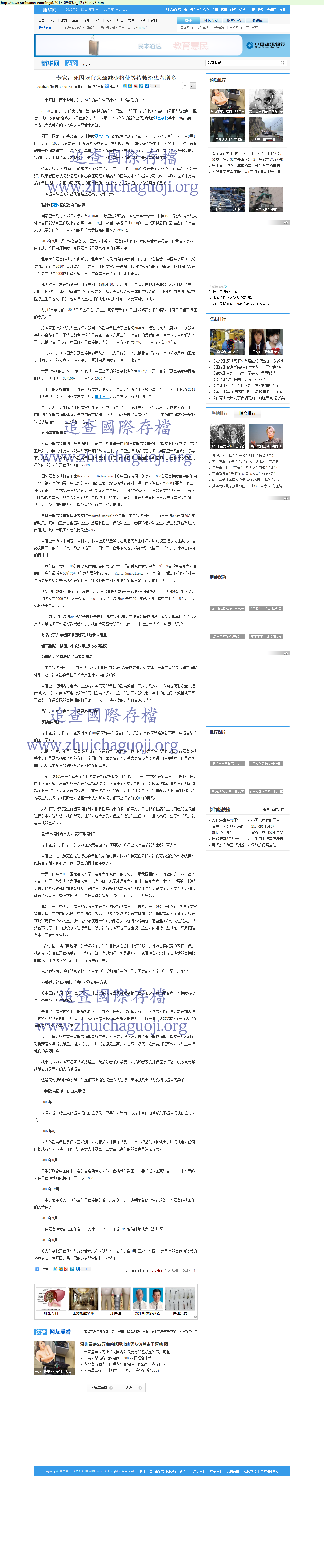
In September 2013, Zhu Jiye, director of the Institute of Organ Transplantation at Peking University, director of the Department of Hepatobiliary Surgery at Peking University People's Hospital, and director of the Organ Transplantation Center at Peking University International Hospital[46], said in an interview with China Economic Weekly: "Before the pilot program was launched in 2010, organs from executed prisoners accounted for almost all of the sources of organ transplantation in China. Our hospital once performed 4,000 liver and kidney transplant surgeries in one year, and all of these organs came from executed prisoners"[47].
In tandem with the CCP’s persecution of Falun Gong, China’s organ transplant market has seen rapid growth since July 1999. In particular, in 2003, the number of organ transplants in China suddenly increased dramatically. Between 2003 and 2006, an international boom of organ transplant tourism to China was launched. The average waiting time for organs in some Chinese hospitals was an unbelievable 1-2 weeks (compared to 2-3 years abroad). Where did so many organs come from? Can death row inmates support the mushroom cloud in China’s organ transplant market?[48] Amnesty International: The average number of executions in China during the five years before and after the CCP’s persecution of Falun Gong was about 1,600 per year.[49]This one hospital alone performed 4,000 liver and kidney transplants a year. According to Ye Qifa, in 2007, there were more than 1,000 hospitals at the peak that could perform organ transplants.[50]Death row inmates were far from meeting the demand for organ transplants. However, Huang Jiefu said in a CCTV interview in July 2018 that "the quality of organs from executed prisoners is very poor, and the requirements for the source of organs are very strict. Such organs cannot be obtained on the execution ground"[51]. This indicates that there are other sources of donors, and Falun Gong practitioners, who cannot obtain legal protection in China, are likely the main source of donors.
VI. The First Meeting of the Seventh Council of Various Branches of the ARSEA
1. The First Meeting of the Seventh Council of the French/Belgium Branch of the ARSEA was held in Beijing
On January 21, 2020, the first meeting of the seventh council of the French/Belgium Branch of the ARSEA (Chinese Overseas Students Association) was held at the Central Institute of Socialism. Members of the sixth council of the French/Belgium Branch, members of the secretariat, and newly elected council members of the seventh council attended the meeting. The meeting elected the seventh council of the French/Belgium Branch of the ARSEA. Yao Tandong, academician of the Chinese Academy of Sciences and first-level researcher of the Institute of Tibetan Plateau Research of the Chinese Academy of Sciences, was elected as the president of the seventh council of the French/Belgium Branch. 14 council members including Jing Guoqing, Liu Gongshe, Liu Zewen, Liu Shuwei, Jiang Bo, Sun Laiyan, Sun Yuanyuan, Li Jingao, Zhang Weihong, Zhou Qi, Zheng Hong, Gu Xingfa, Dong Qiang, and Xiong Sidong were elected as vice presidents[52].
In his work report, Liu Gongshe, Executive Vice President of the Sixth Council of the French/Belgium Branch, pointed out that the French/Belgium Branch actively responded to the call of the General Association and deeply participated in activities organized by the General Association, such as the Sino-French Cultural Forum and poverty alleviation efforts. Yao Tandong, the newly elected President of the Seventh Council of the French/Belgium stated in his speech that the new leadership of the branch should continue to earnestly study the spirit of the important speech delivered by Xi Jinping, the leader of the Communist Party of China, at the celebration of the 100th anniversary of the founding of the ARSEA
2. The first meeting of the seventh council of the US Branch of the ARSEA was held in Beijing.
On January 18, 2020, the first meeting of the seventh council of the US Branch of the ARSEA was held at the Central Institute of Socialism. Members of the sixth council of the US Branch of the ARSEA, members of the secretariat, and newly elected council members of the seventh council attended the meeting. The meeting elected the seventh council of the US Branch of the ARSEA, and Wang Chunfa, director of the National Museum of China, was elected as the president of the seventh council. Wang Shengdi, Wang Yue, Deng Zhonghan, Gu Hongmei, Liu Xingyan, Liu Libin, Liu Xuelin, Duan Yanwen, Yuan Yuyu, Xu Hongcai, Gao Zhikai, Gao Chao, Liang Jianzhang, Lu Junqun, Lei Jianbo and other 15 council members were elected as vice presidents.[53]
3. The first meeting of the seventh council of the UK Branch of the ARSEA was held in Beijing.
On January 11, 2020, the first meeting of the seventh council of the UK Branch of the ARSEA was held at the Central Institute of Socialism. Members of the sixth council of the UK Branch, members of the secretariat, and newly elected council members of the seventh council attended the meeting. The meeting elected the leadership of the seventh council of the UK Branch of the ARSEA. Gao Fu, academician of the Chinese Academy of Sciences and director of the Chinese Center for Disease Control and Prevention, was elected as the president of the seventh council of the UK Branch. Wang Lan, Feng Jun, Yan Aoshuang, Tang Tao, Li Zhijian, Wu Xinghua, Song Yonghua, Zhang Ning, Zhang Zhenyu, Chen Fayun, Chen Ruiping, Luo Zhuohui, He Bingxin, Tao Qinghua, Liao Min, Huo Qigang and 16 others were elected as vice presidents.[54]
In his work report, Luo Zhuohui, Executive Vice President of the Sixth Council of the UK Branch of the ARSEA, stated that the Sixth Council focused on leveraging the collective effectiveness of returned overseas students. Gao Fu, in his speech, indicated that the new council of the UK Branch of the ARSEA must maintain a high degree of consistency with the CCP Central Committee with Xi Jinping at its core. Cheng Hongming, a member of the Party Committee, Deputy Secretary-General, member of the Leadership Group for the Re-election, and Deputy Head of the Re-election Working Group of the ARSEA, pointed out in his speech that in recent years, the ARSEA has thoroughly implemented the spirit of Xi Jinping's important speeches on the work of the ARSEA and returned overseas students, as well as the spirit of the CCP's reform of mass organizations. Under the leadership of the new council, the UK Branch of the ARSEA should strengthen ideological and political guidance and continue to contribute its strength to the mission of serving the country through overseas study.
4. The First Meeting of the Second Council of the Southeast Asia and South Asia Branch of the ARSEA was held in Beijing.
On January 14, 2020, the first meeting of the second council of the Southeast Asia and South Asia Branch of the ARSEA was held at the Central Institute of Socialism. Members of the first council, the secretary-general, and the newly elected council members of the second council attended the meeting. The meeting elected the second council of the Southeast Asia and South Asia Branch of the ARSEA. Han Fangming, vice chairman of the Foreign Affairs Committee of the National Committee of the Chinese People's Political Consultative Conference and vice president of the ARSEA, was elected as the president of the second council. Ten council members, including Wang Ji, Wang Kejian, Wang Jinbao, Liu Xing, Li Shichang, Chen Desheng, Yi Changliang, Zhou Hucheng, Hong Jingfang, and Huang Wei, were elected as vice presidents.
In his speech, Han Fangming, the newly elected president of the second council of the Southeast Asia and South Asia branch, pointed out that Southeast Asian and South Asian countries are all friendly neighbors of China and important development areas in the "Belt and Road" initiative.[55]
5. The first meeting of the seventh council of the Nordic branch of the ARSEA was held in Beijing.
On January 14, 2020, the first meeting of the seventh council of the Nordic branch of the ARSEA(Chinese Overseas Students Association) was held at the Central Institute of Socialism. Members of the sixth council of the Nordic branch, members of the secretariat, and newly elected council members of the seventh council attended the meeting. The meeting elected the seventh council of the Nordic branch of the ARSEA, and Yuan Zhiming, president of the Wuhan branch of the Chinese Academy of Sciences, was elected as the president of the seventh council of the Nordic branch. Ten council members, including Ding Yan, Ma Cungen, Wang Fenliang, Chen Chusheng, Zhao Jianjun, Huang Ruiqing, Ge Li, Han Yu, Lu Yu, and Zhan Weidong, were elected as vice presidents.[56]
Zhao Shiqian, president of the sixth council of the Nordic Branch, pointed out in his work report that the Nordic Branch implements the work deployment of the General Association and pays attention to major national development strategies.
Yuan Zhiming, the newly elected president of the seventh council of the Nordic Branch, pointed out in his speech that the new president's board and council will continue to strengthen ideological and political leadership, closely integrate the characteristics of study abroad countries such as Denmark, Sweden, Norway, Finland, Iceland, the Netherlands, and Greece, and contribute to the development and growth of the ARSEA.
6. The first meeting of the seventh council of the Soviet Union Branch of the ARSEA was held in Beijing.
On January 12, 2020, the first meeting of the seventh council of the Soviet Union Branch of the ARSEA was held at the Central Institute of Socialism. More than 140 people attended the meeting, including members of the sixth council of the Soviet Union Branch, members of the secretariat, and newly elected council members of the seventh council. The meeting elected the council of the seventh council of the Soviet Union Branch of the ARSEA. Liu Limin, vice president of the Soviet Union Branch of the ARSEA, former vice minister of the Ministry of Education, and president of the China Education Association for International Exchange, was elected as the president of the seventh council of the Soviet Union Branch of the ARSEA. Sixteen council members, including Gu Zong, Ning Qi, Gulili Abuduwaili, Liu Zhengping, Liu Hong, Liu Baolin, Guan Xueling, An Songlin, Li Dingxin, Wu Hongwei, Zhang Shuibao, Zhang Yuxing, Zhou Liqun, Zhao Lingshan, Xiong Jian, and Wei Xinmin, were elected as vice presidents.[57]
In his speech, Liu Limin, the newly elected president of the seventh council of the Soviet Union Branch of the ARSEA, emphasized that the new council should highlight its political nature and play a greater role in ideological guidance.
7. The first meeting of the sixth council of the Latin American branch of the ARSEA was held in Beijing.
On January 15, 2020, the first meeting of the sixth council of the Latin American branch of the ARSEA (China Overseas Students Association) was held at the Central Institute of Socialism. Members of the fifth council of the Latin American branch, members of the secretariat, and newly elected council members of the sixth council attended the meeting. The meeting elected the sixth council of the Latin American branch of the ARSEA. Wang Weihua, former Consul General in Guayaquil, former representative to the Dominican Republic and the Republic of Panama, and former Chargé d'affaires of the Chinese Embassy in Panama, was elected as the president of the sixth council of the Latin American branch. Eight council members, including Ai Kuiyu, Zhang Yongjun, Zhang Lei, Lin Hai, Zhou Zhiwei, Zhao Juli, Pu Jie, and Lei Hong were elected as vice presidents.[58]
In her work report, Chen Hongdi, Vice President of the Fifth Council of the Latin American Branch, pointed out that the Latin American Branch emphasizes strengthening political guidance, taking the requirements of CCP leader Xi Jinping regarding the ARSEA as "a talent pool for serving the country, a think tank for providing advice and suggestions, and a vital force in people-to-people diplomacy" as its working guide. Through organizing Latin American-themed activities such as commemorating the 50th anniversary of studying in Cuba and the China-Latin America Cultural Exchange Year, it has become a bridge and link with Spain, Portugal, and Latin American countries where students studied. Wang Weihua, the newly elected President of the Sixth Council of the Latin American Branch, stated in his speech that the ARSEA in the new era shoulders the important trust of the CCP.
8. The first meeting of the seventh council of the German and Austrian branch of the ARSEA was held in Beijing.
On January 15, 2020, the first meeting of the seventh council of the German and Austrian branch of the ARSEA (China Overseas Students Association) was held at the Central Institute of Socialism. Members of the sixth council of the German and Austrian branch, members of the secretariat, and newly elected council members of the seventh council attended the meeting. The meeting elected the seventh council of the German and Austrian branch of the ARSEA. Pan Jianwei, academician of the Chinese Academy of Sciences and executive vice president of the University of Science and Technology of China, was elected as the president of the seventh council of the German and Austrian branch. Sixteen council members, including Wang Wensheng, Liu Qiang, Du Shengyong, Li Dan, Li Xing, Shi Yonghong, Wu Yuhua, Wu Zhiqiang, Chen Hongjie, Zhou Ying, Zhao Bin, Zhao Zhensheng, Luo Jianming, Xu Tao, Guo Jianbin, and Xie Yinglong were elected as vice presidents.[59]
Li Dan, Secretary-General of the German-Austrian Branch, pointed out in the work report of the sixth council that the German-Austrian Branch strives to build ideological consensus and strengthen management mechanisms.
Pan Jianwei, the newly elected president of the seventh session of the Board of Directors of the German and Austrian Branch, pointed out in his speech that this meeting elected the leadership team of the seventh session of the Board of Directors. In the next five years, the German-Austrian branch will combine the characteristics of its members and Germany, Austria and other countries to realize the Chinese dream of the great rejuvenation of the Chinese nation.
9. The first meeting of the eighth council of the Italian branch of the ARSEA was held in Beijing.
On January 15, 2020, the first meeting of the eighth council of the Italian branch of the ARSEA was held at the Central Institute of Socialism. Members of the seventh council of the Italian branch of the ARSEA, members of the secretariat, and newly elected council members of the eighth council attended the meeting. The meeting elected the council of the eighth council of the Italian branch of the ARSEA. Wang Yifang, academician of the Chinese Academy of Sciences and director of the Institute of High Energy Physics of the Chinese Academy of Sciences, was elected as the president of the eighth council of the Italian branch of the ARSEA. Six council members, including Wang Xiu, Wen Zheng, Xing Jianjun, Liu Xingrong, Liu Ronghui, and Wu Junfeng, were elected as vice presidents.[60]
In his work report, Zheng Quan, President of the 7th Council of the Italian branch of the ARSEA, pointed out that the Italian branch, with the study and implementation of the spirit of the 19th CCP National Congress as its main theme, guided returned overseas students to contribute their wisdom.
In his speech, Wang Yifang, the newly elected President of the 8th Council of the Italian branch of the ARSEA, stated that the branch will thoroughly implement the spirit of the important speech delivered by CCP leader Xi Jinping at the celebration of the 100th anniversary of the founding of the ARSEA, continuously improve its political stance, strengthen its sense of responsibility, closely focus on the overall work of the CCP and the country, and, under the guidance of the General Association, promote the work of the Association with greater efforts and more practical measures.
10. The first meeting of the seventh council of the Canadian branch of the ARSEA was held in Beijing.
On January 18, 2020, the first meeting of the seventh council of the Canadian branch of the ARSEA was held at the Central Institute of Socialism. Members of the sixth council of the Canadian branch of the ARSEA, members of the secretariat, and newly elected council members of the seventh council attended the meeting. The meeting elected the seventh council of the Canadian branch of the ARSEA. Yao Wang, former senior executive director of the Boao Forum for Asia and former president of the Beijing Council for the Promotion of International Trade, was elected as the president of the seventh council of the Canadian branch of the ARSEA. Ten council members, including Wang Yachun, Bai Ning, Liu Yu, Liu Jiafeng, Yan Changming, Li Haiqing, Yang Baofeng, Wu Jianping, Xiao Peng, and Cheng Guangxu, were elected as vice presidents.[61]
In his speech, Yao Wang, the newly elected president of the 7th Council of the Canadian branch of the ARSEA expressed his gratitude for the solid foundation laid by the 6th Council and previous councils, as well as the sound working mechanisms and atmosphere established. The Canadian branch will continue to strengthen ideological and political guidance, and under the leadership of the General Association, fully leverage its advantage of familiarity with both Chinese and Canadian languages and cultures, utilize the strengths and characteristics of its internationally-minded personnel, tell the story of China (the Communist Party of China) well, and serve as a bridge and link in people-to-people diplomacy between China and Canada.
11. The first meeting of the sixth council of the Swiss branch of the ARSEA was held in Beijing.
On January 16, 2020, the first meeting of the sixth council of the Swiss branch of the ARSEA (China Overseas Students Association) was held at the Central Institute of Socialism. Members of the fifth council of the Swiss branch, members of the secretariat, and newly elected council members of the sixth council attended the meeting. The meeting elected the sixth council of the Swiss branch of the ARSEA, and Tang Zhiyong, deputy director and researcher of the National Center for Nanoscience and Technology, was elected as the president of the sixth council of the Swiss branch. Seven members, including Ai Bo, Qu Zhaosong, Yang Zhou, Zhang Jianxin, Chen Xiaofeng, Jin Jing, and Gao Xiang were elected as vice presidents[62].
In his work report, Ai Bo, President of the Fifth Council of the Swiss Branch, pointed out that under the guidance of the General Association, the Swiss Branch has deepened and expanded people-to-people diplomacy between China and Switzerland through various means, including receptions at the Swiss Embassy, high-level forums, and the publication of the book series "Years in Switzerland," thus amplifying the voice of China (the CCP) and expanding international connections.
In his speech, Tang Zhiyong, the newly elected President of the Sixth Council of the Swiss Branch, stated that the Swiss Branch, building on its past achievements, will be guided by Xi Jinping Thought on Socialism with Chinese Characteristics for a New Era, and will complete all tasks according to the overall plan and work arrangements of the General Association.
12. The First Meeting of the Fourth Council of the Australia and New Zealand Branch of the ARSEA was held in Beijing.
On January 17, 2020, the first meeting of the Fourth Council of the Australia and New Zealand Branch of the ARSEA was held at the Central Institute of Socialism. Members of the Third Council, the Secretary-General, and newly elected council members attended the meeting. The meeting elected the President of the Fourth Council of the Australia and New Zealand Branch of the ARSEA. Zhang Baiqing, President of the Hubei branch of the ARSEA and Chairman of the Board of Directors of Zhongnan Engineering Consulting & Design Group Co., Ltd., was elected as the President. Ten council members, including Ma Yun, Wang Na, Shi Jie, Qiao Luqiang, He Yuanping, Gu Huimin, Zhang Xiping, Chen Chunyu, Zheng Fuhu, and Dong Guohai, were elected as Vice Presidents.
In his work report, Qiao Luqiang, president of the third council of the Australia and New Zealand branch, pointed out that the Australia and New Zealand branch closely followed the work deployment of the General Association, combined with the new domestic and international situation and the characteristics of the branch, and actively promoted the work of offering suggestions and advice in various fields such as science and technology, culture, and education. In his speech, Zhang Baiqing, the newly elected president of the fourth council of the Australia and New Zealand branch, pointed out that the Australia and New Zealand branch should take political leadership as the main axis under the strong guidance of the General Association of ARSEA, raise its political stance, and ensure that the branch always adheres to the correct political direction. It should serve the overall work of the General Association in accordance with the requirements of "talent pool", "think tank" and "new force", and widely discover and attract alumni who have studied in Australia and New Zealand.[63]
13. The first meeting of the fifth council of the Japan branch of the ARSEA was held in Beijing.
On January 19, 2020, the first meeting of the fifth council of the Japan branch of the ARSEA was held at the Central Institute of Socialism. Members of the fourth council of the Japan Branch, members of the secretariat, and newly elected council members of the fifth council attended the meeting. The meeting elected the fifth council of the Japan branch of the ARSEA. Cao Weizhou, member of the Standing Committee of the 12th National People's Congress, deputy secretary-general, deputy director of the Foreign Affairs Committee, and vice president of the ARSEA, was elected as the president of the fifth council of the Japan Branch. Fourteen council members, including Wang Zhongyi, Niu Zhongying, Wen Chengfeng, Bai Gang, Feng Haiquan, Xiang Yong, Li Xiaobei, Li Junfeng, Shao Fengjing, Zhou Zhouyu, Fang En, Ni Yueju, Gao Tongqiang, and Zhai Xianwen, were elected as vice presidents.[64]
In his work report, Cao Weizhou, president of the fourth council of the Japan branch of the ARSEA, pointed out that under the leadership of the general association, the Japan Branch, uniting and leading its members, has made due efforts and contributions to promoting the construction of socialism with Chinese characteristics and the people-to-people diplomacy between China and Japan.
In his speech, Cao Weizhou, the newly elected president of the fifth council of the Japan branch, stated that the new council will certainly live up to the trust of all council members, continue to strengthen ideological guidance, constantly enhance the "Four Consciousnesses," strengthen the "Four Confidences," and achieve the "Two Safeguards."
14. The first meeting of the fourth council of the North and South Koreas Branch of the ARSEA was held in Beijing.
On January 17, 2020, the first meeting of the fourth council of the North and South Koreas Branch of the ARSEA (China Overseas Students Association) was held at the Central Institute of Socialism. Members of the third council of the North and Sough Koreas Branch, members of the secretariat, and newly elected council members of the fourth council attended the meeting. The meeting elected the fourth council of the North and South Koreas branch, and Xin Baozhong, secretary of the Party Committee of Harbin Normal University, was elected as the president of the fourth council of the North and South Koreas Branch. Eight council members, including Wang Dan, Sun Hongtao, Zhao Weihong, Zhao Yuping, Tie Changsheng, Gao Zhiquan, Han Xiandong, and Wei Yanyu were elected as vice presidents.[65]
Wang Linchang, president of the third council of the North and South Koreas branch, pointed out in his work report that the North and South Koreas branch pays attention to the ideological and political guidance of members, widely builds consensus, continuously strengthens organizational construction, actively responds to and participates in various meetings and activities organized by the General Association, and builds a platform for cooperation and exchange by organizing various forums and conferences such as the "East Asia Security Forum".
Xin Baozhong, the newly elected president of the fourth council of the North and Sough Koreas branch, pointed out in his speech that the branch should unite and contact students studying in North Korea and South Korea to the greatest extent, especially those who have returned from North and South Korea, in accordance with the deployment of the General Conference and the branch development plan, and make the work of the branch more practical, detailed and better through sororities, academic exchanges, organizational forums and other forms.
15. The First Meeting of the Seventh Council of the Central and Eastern European Branch of the ARSEA Was Held in Beijing.
On January 19, 2020, the first meeting of the Seventh Council of the Central and Eastern European Branch of the ARSEA was held at the Central Institute of Socialism. Members of the Sixth Council, the Secretary-General, and newly elected council members attended the meeting. The meeting elected the Seventh Council of the Central and Eastern European Branch of the ARSEA. Liu Yuening, Vice President of the ARSEA, Professor at the Central Conservatory of Music, and Director of the Confucius Institute for Music and the Sino-Foreign Music Culture Exchange and Experience Base, was elected as the President of the Seventh Council. Eight council members, including Wang Peng, Fan Jianping, Su Yanwen, Li Yuebo, Zhang Dongming, Hao Qiang, Peng Yuchao, and Peng Bo, were elected as Vice Presidents.
In her work report, Li Mei, Executive Vice President of the Sixth Council of the Central and Eastern European branch, pointed out that the Central and Eastern European branch has taken practical actions to promote exchanges and cooperation between China and Central and Eastern European countries in the fields of politics, culture, art, science and education, and trade, and actively responded to the "Belt and Road" initiative. The group advantages and overall role of students studying in Central and Eastern European countries have been continuously strengthened[66]. In her speech, Liu Yuening, the newly elected President of the Seventh Council of the Central and Eastern European branch, pointed out that the new council will inherit the glorious tradition of the association, recruit more students and experts from Central and Eastern Europe, establish a more systematic and practical talent pool, and build a better career platform; give full play to the strengths of students studying abroad and help promote the development and prosperity of countries along the "Belt and Road"; and continue to do a good job in brand activities such as the "Friendship Day between China (CCP) and Central and Eastern European Countries".
The contents of the aforementioned branch reshuffle meetings reveal that the various branches of the ARSEA demonstrate a high degree of political identification with and organizational obedience to the CCP in their organizational structure, leadership selection, meeting agendas, and work priorities. The branches generally prioritize "ideological and political guidance," emphasizing the study and implementation of the spirit of CCP leader Xi Jinping's important speeches, maintaining a high degree of consistency with the CCP, and positioning the returned overseas students as an important force serving national strategies, united front work, and international exchanges. This indicates that, in practice, the ARSEA branches have become organizational units with clearly defined political functions within the CCP's united front system.
Ⅵ. The ARSEA Conducts United Front Activities Overseas
In 2003, the ARSEA added the name "Chinese Overseas Students Association" to give full play to its talent and intellectual advantages, establish a base for studying abroad to serve the country, offer suggestions to the CCP and the government, and do a good job in serving high-level overseas talents[67]. In 2013, at the celebration of the 100th anniversary of the founding of the ARSEA, CCP leader Xi Jinping pointed out that the ARSEA "should give full play to its characteristics and advantages of being mass-based, highly educated, and united front-oriented, based in China and expanding overseas, and strive to become a talent pool for studying abroad to serve the country, a think tank for offering suggestions, and a vital force for carrying out people-to-people diplomacy."
1.The ARSEA conducts various political activities of the CCP, promotes the CCP ideology to overseas returnees, and demands their loyalty to the CCP.
On May 18, 2021, the ARSEA held its first 2021 "Understanding the National Situation and Talking about Confidence" series of symposiums for overseas returnees. The ARSEA set up the main venue, and 30 provincial-level ARSEA organizations across the country set up branch venues. More than 300,000 netizens watched the live broadcast online.[68]
Xin Xiangyang, a researcher, secretary of the Party Committee and vice president of the Institute of Marxism Studies of the Chinese Academy of Social Sciences and dean of the School of Marxism of the University of Chinese Academy of Social Sciences, said that the most fundamental reason is that the leadership of the CCP has guaranteed our political stability.
Wang Pijun, Secretary of the Party Group and Secretary-General of the ARSEA, said at the meeting that "at this important historical moment of the centenary of the founding of the Communist Party of China, and in the first stage of the vigorous study and education of Party history carried out by the whole Party, the ARSEA, as a people's organization led by the Party, has great practical significance in carrying out such activities." Sun Bingqing, a member of the Hebei branch of the ARSEA, said that he had participated in planning the visit of young members of the Hebei branch of the ARSEA to Xibaipo, a revolutionary holy site.
On September 26, 2024, the ARSEA Lecture Hall and the Symposium for Overseas Students to Celebrate the 75th Anniversary of the Founding of the People's Republic of China, with the theme of "Implementing the spirit of the Third Plenary Session of the 20th CCP Central Committee and contributing the strength of overseas students to the promotion of Chinese-style modernization," was held in Beijing. Ding Zhongli, Vice Chairman of the Standing Committee of the National People's Congress and President of the ARSEA (China Overseas Students Association), attended and delivered a speech. Li Min, Secretary of the Party Group and Secretary-General of the ARSEA, presided over the symposium. Vice presidents of the ARSEA in Beijing, including Liu Limin and Yao Wang, members of the secretariat of the ARSEA, and relevant representatives of the ARSEA's national branches, group members and committees participated in the event.[69]
Ding Zhongli stated that holding this symposium on the occasion of the Third Plenary Session of the 20th CCP Central Committee and the 75th anniversary of the founding of the People's Republic of China not only demonstrates the love of overseas returnees for the CCP and the country, but also represents an important measure and vivid practice for members of various organizations at all levels to take the lead in studying Xi Jinping Thought on Socialism with Chinese Characteristics for a New Era and the spirit of the Third Plenary Session of the 20th CPC Central Committee. Furthermore, it serves as a grand forum for ideological guidance among overseas returnees, fully demonstrating the political nature and progressiveness of the ARSEA.
On December 5, 2024, the Third Meeting of the Eighth Council of the ARSEA (China Overseas-Educated Scholars Association) opened in Beijing. Ding Zhongli, Vice Chairman of the Standing Committee of the National People's Congress and President of the ARSEA, delivered a work report on behalf of the Eighth Council. Ding Zhongli emphasized that for more than a year, the ARSEA has consistently taken the spirit of Xi Jinping's congratulatory letter on the 110th anniversary of the association's founding as its fundamental guideline, leading overseas returnees to actively participate in the comprehensive deepening of reforms. To do a good job in the key tasks of the ARSEA in 2025, we must thoroughly study and implement Xi Jinping's Thought on Socialism with Chinese Characteristics for a New Era, and integrate ideological and political guidance into all activities; we must stimulate the vitality of the talent pool of returned students who serve the country, the think tank that offers advice and suggestions, and the vital force of people-to-people diplomacy, and contribute to China's (CCP) modernization.[70]
2.Promoting Global Returned Talents to Serve the CCP
The ARSEA has created platforms such as the "Double Innovation" Competition, Returned Scholar Towns, and Overseas Innovation Centers. These three platforms are integrated to promote the return of overseas students to serve the country [71].
Since 2018, the ARSEA has joined forces with local governments to build Returned Scholar Towns. By accurately gathering returned overseas students and various talents studying abroad, each Returned Scholar Town focuses on a high-tech industry. Currently, Returned Scholar Towns focusing on intelligent manufacturing, digital medicine, Internet of Things, and aerospace equipment industries have been unveiled in Changsha, Hangzhou, Wuxi, and Zhuji, respectively.
It is understood that since October 2020, the ARSEA has held two consecutive "Innovation and Entrepreneurship" competitions. The competitions focused on emerging industries and cutting-edge technologies such as artificial intelligence, biomedicine, information technology, healthcare, and intelligent manufacturing, not only helping participating companies and teams improve their projects but also providing them with tangible channels to connect with capital and the market.
Establishing regional innovation centers nationwide is another important measure in building a "talent pool." In October 2020, the ARSEA Yangtze River Delta Innovation Center was officially completed and put into operation; in December 2021, the Shanghai branch of the Yangtze River Delta Innovation Center was officially unveiled. Currently, innovation centers in Northwest, Southwest, Central, Southeast, and Northeast China are under construction.
On October 25, 2025, the "Zhejiang Unity and Passing on the Torch" meeting for new and old members of the Hangzhou High-tech Zone (Binjiang) ARSEA and the "Overseas Returnees in Zhejiang Gather to Discuss Development" 2025 Overseas Famous University Alumni in Zhejiang Sharing and Exchange Activity were held in Hangzhou. Under the guidance of the United Front Work Department of the CCP Hangzhou High-tech Zone (Binjiang), the event was jointly organized by the Hangzhou High-tech Zone (Binjiang) Overseas Returnees Association and the Alliance of Overseas Famous University Alumni Organizations in Zhejiang. It attracted more than 300 overseas returnees from well-known universities around the world to gather together and inject stronger "overseas returnee power" into Zhejiang's high-quality development[72].
In order to deepen exchanges, cooperation and resource sharing, a cooperation signing ceremony was held at the event between the Hangzhou High-tech Zone (Binjiang) Overseas Returnees Association and representatives of overseas famous university alumni organizations in Zhejiang, so as to further broaden the service platform for overseas returnees in Zhejiang and improve the network of overseas returnees. Yuan Haifeng, Executive Deputy Minister of the United Front Work Department of the CCP Hangzhou High-tech Zone (Binjiang) Party Committee and Chairman of the Overseas Chinese Federation, said that he would continue to support the work of the ARSEA.
3.Actively engage in people-to-people diplomacy, organize international exchange activities, and establish a united front network
The ARSEA actively engages in people-to-people diplomacy, expanding its external connections. Through seminars and other means, it strengthens communication with leaders of overseas student groups; through sending delegations abroad and receiving visitors, it enhances communication and cooperation with embassies and consulates overseas to understand and grasp the dynamics and needs of overseas scholars.
People-to-people diplomacy is increasingly becoming an important diplomatic model for the CCP. The ARSEA, as described by CCP leader Xi Jinping at the ARSEA's 100th anniversary celebration as a "vital force in people-to-people diplomacy," utilizes its signature people-to-people diplomacy activities such as the "China-France Cultural Forum," the "China-Germany Science and Technology Forum," the "China-US Economic and Trade Forum," and the "21st Century China Forum" to tell China's story and disseminate CCP values.
As of October 2023, the China-France Cultural Forum had been held four times, the China-Germany Science and Technology Forum three times, the China-US Economic and Trade Forum twice, and the "21st Century China" Forum, founded in 1996, had been held 17 times. In addition, events such as the "Forum Commemorating the 50th Anniversary of Chinese Government-Sponsored Students Studying in the UK" have helped the CCP expand its influence.
The China-France Cultural Forum, founded in 2016, focuses on themes such as dialogue and integration of civilizations, cultural exchange and sharing, mutual learning and innovation among civilizations, and dialogue and win-win cooperation among civilizations under the "Belt and Road" initiative. It has become a brand event in the field of Sino-French cultural exchange and an important window for disseminating the CCP's party culture and the story of the CCP regime to the outside world.
The ARSEA also held a Spring Festival gathering in 2014, which invited more than 100 ambassadors from more than 50 major countries where Chinese overseas students study to attend. The association also held a series of activities through its branches, including "Celebrating the 65th Anniversary of the Establishment of Diplomatic Relations between China (the CCP) and Central and Eastern European Countries and a Themed Concert", "Celebrating the 50th Anniversary of the Establishment of Diplomatic Relations between China and France and Returning to France", and "Celebrating the 54th Anniversary of the Establishment of Diplomatic Relations between China and Cuba and the 50th Anniversary of the First Batch of Chinese Students Going to Cuba".[73]
The China-France Cultural Forum was jointly initiated by Chen Zhu, Vice Chairman of the Standing Committee of the National People's Congress and President of the ARSEA, and Jean-Pierre Raffarin, former Prime Minister of France, in 2016. It has become a brand activity in the field of Sino-foreign cultural exchanges and has been included in the high-level people-to-people exchange mechanism between the Chinese and French governments.[74] As of January 2021, the China-France Cultural Forum, hosted by the ARSEA and the French Foundation for Prospect and Innovation, has been held four times.
Mr. Raffarin, as the French Chairman of the China-France Cultural Forum, has visited China multiple times. In 2019, on the occasion of the 70th anniversary of the founding of the People's Republic of China, he was awarded the "Friendship Medal" by the Chinese (CCP) government. He has long been committed to promoting Sino-French friendship and all-round cooperation between the two countries, vigorously promoting the "Belt and Road" cooperation, and actively offering suggestions for France and various sectors in Europe to objectively understand and actively participate in the "Belt and Road" cooperation.
As a new platform for scientific and cultural exchange and cooperation between China and Germany, the China-Germany Science and Technology Culture Forum aims to build a platform for discussion among government, scientific and technological communities, and businesses, and to promote extensive cooperation and exchange between China and Germany in the fields of science and technology, trade and economy, and culture. The first China-Germany Science and Technology Culture Forum was held in Berlin, Germany on October 11, 2018. Chen Zhu, Vice Chairman of the Standing Committee of the National People's Congress and President of the ARSEA; Reiner Gieschubel, Special Advisor to the German Federal Minister of Food and Agriculture; and Frank Henkel, Member of the Berlin State Parliament, former Mayor of Berlin, and former Minister of the Interior of Berlin, attended the forum and delivered speeches. The forum focused on in-depth exchanges on Sino-German scientific and cultural cooperation, the Belt and Road Initiative, and the concept of a community with a shared future for mankind. More than 100 dignitaries, members of parliament, and representatives from the economic, scientific, and cultural fields from both China and Germany attended the event. The themes of the main forum and the three sub-forums were "Mutual Learning," "Enhancing Cooperation," "Seizing the Opportunities of the Belt and Road Initiative to Promote Faster and Better Development for Both Countries," and "Working Together to Build a Community with a Shared Future for Mankind and Make Tomorrow a Better Day for the World."
The second China-Germany Science and Technology Forum, with the theme of "Sino-German Science and Technology Innovation and Development in the New Era", opened in Beijing on November 19, 2019. Chen Zhu, Vice Chairman of the Standing Committee of the National People's Congress and President of the ARSEA; Hans-Peter Friedrich, Deputy Speaker of the German Bundestag; Yan Aoshuang, Deputy Director of the Standing Committee of the Beijing Municipal People's Congress and President of the Beijing ARSEA; Alexander Kulitz, Member of the German Bundestag and Member of the Foreign Affairs Committee of the Liberal Democratic Party attended the opening ceremony and delivered speeches.
With the joint promotion from both parties, at the second China-Germany Science and Technology Forum, the ARSEA and the German Federal Federation for Economic Development and Foreign Trade signed a strategic cooperation memorandum.
In June 2019, against the background of the escalation of Sino-US trade friction, a ARSEA delegation went to the United States to hold the "China-US Economic and Trade Forum" and the "China-US Humanities Dialogue" in New York and Washington D.C. respectively [75].
On June 12, 2019, Eastern Time, the first China-US Economic and Trade Forum was held in New York City. The forum included three themes: "China-US People-to-People Economic and Trade Cooperation and Win-Win Results," "Prospects for China-US People-to-People Financial Relations," and "Innovation and Development Opportunities for China-US Enterprises." Wang Pijun, Secretary-General of the ARSEA and head of the delegation; Li Xinyu, Director of the Center for People-to-People Diplomacy Strategy Research of the Chinese People's Association for Friendship with Foreign Countries; Xu Hongcai, Vice Chairman of the Economic Policy Committee of the China Policy Science Research Association; Gao Zhikai, Chairman of the China Institute at Yale Law School and Director of the China Energy Security Institute; Ren Xiao, Director of the Center for China Diplomacy Studies at Fudan University; Li Zhijian, Chairman of the Asia-Pacific Institute for Innovative Economics; Sun Jinsong, Professor at the Party School of the Central Committee of the Communist Party of China (National Academy of Governance); Bob Rolfe, Director of the Tennessee Department of Economic and Social Development; Russell Flannery, Chief China Advisor of Forbes Global Media Holdings and Editor-in-Chief of Forbes China; and Chen Xiaozhen, Partner at Ernst & Young, for a total of 14 Chinese and American guests, delivered speeches. More than 100 guests from the economic, trade, and cultural fields of China and the United States attended the forum.
On June 13, 2019, Eastern Time, the ARSEA held a "China-US People-to-People Dialogue" in Washington, D.C. Six experts from the ARSEA’s Belt and Road Initiative Research Institute and eleven experts from several well-known U.S. think tanks in the fields of international strategy and trade conducted in-depth exchanges on "How to Contribute to Building a Sound China-US Relationship."
The "21st Century China" Forum, founded by the ARSEA in 1996, aims to strengthen ties and exchanges between the CCP and other countries, further build consensus, and contribute wisdom and strength to the harmonious development of all countries and the joint construction of a "community with a shared future for mankind." The forum has been held 16 times in cities around the world, including Beijing, Houston, Frankfurt, Sydney, The Hague, Paris, Rome, and Lausanne. Participation has steadily increased, its coverage has expanded, and its influence has grown, making it a long-standing and influential brand activity for the ARSEA's people-to-people diplomacy.
On October 11, 2019, London time, the 17th "21st Century China" Forum was held at the Royal Society in the UK, with the theme of "China-UK Cooperation in Science, Technology and Finance". Chen Zhu, Vice Chairman of the Standing Committee of the National People's Congress of the Communist Party of China and President of the ARSEA; Liu Xiaoming, Chinese Ambassador to the UK; Liu Limin, former Vice Minister of Education and Vice President of the ARSEA; Mike Bates, former Deputy Speaker of the House of Lords and former Minister of State for the Home Office; David Willetts, former Minister of State for Science and Universities; and Richard Cattlow, Vice President of the Royal Society, attended the forum. More than 100 experts, scholars, entrepreneurs, and youth representatives in the fields of science, technology, finance, and education from China and the UK participated in the forum.
On May 19, 2018, in order to summarize the achievements of the Belt and Road Initiative in Southeast Asia and South Asia over the past five years and to accelerate the pace of Chinese enterprises "going global" to build the Belt and Road, the Southeast Asia and South Asia Branch of the ARSEA and the Charhar Institute jointly hosted the Southeast Asia and South Asia Regional Belt and Road Construction Roundtable Forum.
On September 9, 2022, the ARSEA (China Overseas Students Association) held a forum in Beijing to commemorate the 50th anniversary of Chinese government-sponsored study in the UK. Ding Zhongli, Vice Chairman of the Standing Committee of the National People's Congress of the CCP and President of the ARSEA (China Overseas Students Association), and Caroline Wood, British Ambassador to China, attended and delivered a speech. Ambassador Zheng Zeguang of the CCP attended and delivered a speech via video. Wang Pijun, Secretary-General of the ARSEA, presided over the meeting. More than 200 people, including government officials, well-known figures in education, scientists, entrepreneurs, and financial figures from China and the UK, participated in the meeting online or offline.[76]
In February 2024, the 2024 Spring Festival Reunion of the ARSEA (China Overseas Students Association) was held on the evening of February 1 at the Great Hall of the People in Beijing. Ding Zhongli, Vice Chairman of the Standing Committee of the National People's Congress and President of the Western Returned Scholars Association, delivered a speech. More than 400 Chinese and foreign guests attended the meeting, including ambassadors and representatives of international organizations from 37 countries, representatives of relevant departments of the CCP Central Committee and the CCP, such as the United Front Work Department of the CCP Central Committee, the General Office of the National Committee of the Chinese People's Political Consultative Conference, the Ministry of Foreign Affairs, the Ministry of Science and Technology, and the Ministry of Human Resources and Social Security, some vice presidents of the ARSEA, presidents and secretaries-general of national branches, local organizations, group members, and professional committees, and some representatives of returned students. The reunion was chaired by Li Min, Secretary-General of the ARSEA.[77]
4.Establish a think tank to provide advice and suggestions to the CCP.
The ARSEA builds teams, sets up platforms, improves mechanisms, and establishes new think tanks. The ARSEA Research Institute is the main support for the think tank to provide advice and suggestions. At present, the institute has established 7 research centers, including the "One Belt and One Road" Research Center, the China-US Relations Research Center, the Guangdong-Hong Kong-Macao Greater Bay Area Research Center, the Overseas Students Research Center, the External Communication Research Center, the Economic Research Center, and the Artificial Intelligence and Digital Economy Research Center.
In September 2018, the first International Think Tank Forum of the ARSEA was held in Xi'an.
From May 15 to 17, 2019, the second International Think Tank Forum and Changpu River Forum of the ARSEA was held at the ARSEA’s centennial site. The forum was themed “China and the World: Openness, Cooperation and Win-Win” and was attended by more than 200 Chinese and foreign guests from more than ten countries including the United States, France, Germany, Russia, South Korea, Singapore, Malaysia, India, Pakistan and Nepal.[78]
The institute's experts focused on both domestic and international issues, offering suggestions on major events and playing a think tank role.
The ARSEA also organized experts from overseas students to hold a number of on-site symposiums in Guangdong, Shanghai, Liaoning and other places to provide advice and suggestions, covering key industries in Guangzhou, the construction of the Shanghai Free Trade Zone, and the revitalization of Northeast China.
Ⅷ. The CCP used overseas Chinese journalists affiliated with united front organizations such as the ARSEA to publish numerous articles attacking Falun Gong and Shen Yun.
The New York Times published several articles attacking Falun Gong and Shen Yun. Insiders from the CCP's public security department revealed that attacking Falun Gong overseas was part of the plan of Chen Yixin, the CCP's new Minister of State Security, to curry favor and gain power. The Ministry of State Security was providing so-called internal materials behind the scenes.[79]
The New York Times has long maintained close ties with the CCP. It is well known that the CCP has always regarded Falun Gong as its number one enemy and has carried out ruthless suppression. The CCP has never made any concessions on the issue of Falun Gong. Therefore, the New York Times’ position on this issue is almost consistent with that of the CCP, and this report is a manifestation of this position. The main reporter of many reports attacking Shen Yun and Falun Gong, Nicole Hong, is a Chinese-American reporter. Her father, Hong Zhaohui, is a member of the United Front Work Department of the CCP, which is responsible for infiltrating overseas and collecting intelligence. He is also a member of the North American branch of the ARSEA, one of the eight United Front Work Departments directly under the CCP, which has received inscriptions from successive CCP leaders, including Deng Xiaoping, Jiang Zemin, Hu Jintao and Xi Jinping, as well as funding from the intelligence department. The reporter’s background has a deep connection with the CCP’s United Front system.[80]
In January 2021, the first National Congress of the ARSEA was held. The congress elected Ding Zhongli, vice chairman of the Standing Committee of the National People's Congress of the Communist Party of China, as the president of the eighth council of the ARSEA. Chen Yixin, the current Minister of State Security of the Communist Party of China, is from Taishun, Zhejiang Province, and has served in Zhejiang for a long time. The Ministry of State Security of the Communist Party of China, which is headed by Chen Yixin, and the ARSEA, the United Front Work Department of the Communist Party of China, which is headed by Ding Zhongli, both carry out secret espionage activities and are deeply connected.[81]
When the relationship between Hong Qianqian and Hong Zhaohui was exposed by overseas media, the Chinese Communist Party’s domestic media immediately deleted the relevant reports. Without the coordination by institutions such as the Central Propaganda Department or the State Council Cyberspace Administration, it would have been impossible for so many domestic media websites to take such coordinated action for a reporter from The New York Times.[82]
IX. The ARSEA has close ties with the Center for China and Globalization.
Wang Huiyao, Vice President of the ARSEA and Director of the Center for China and Globalization (CCG) [83].
The Center for China and Globalization (CCG) is a leading international think tank in China. It is a council member of the Belt and Road Think Tank Alliance of the International Department of the Central Committee of the Communist Party of China, a national talent theory research base of the Central Leading Group for Talent Work, the location of the International Talent Professional Committee of the China Talent Research Association of the Ministry of Human Resources and Social Security, a founding council member of the "American Studies Think Tank Alliance" of the Ministry of Finance, and possesses the qualification of a postdoctoral research station granted by the state. It is also the only Chinese think tank to have obtained special consultative status from the United Nations.
Founded in 2008, CCG boasts nearly 100 full-time think tank researchers and professionals, making it a leading social think tank in China. Headquartered in Beijing and registered with the Ministry of Civil Affairs, CCG has established research institutions in Beijing, three research institutes in Guangzhou, Qingdao, and Dongguan, and branch offices in Shanghai, Shenzhen, and Chengdu. It also has overseas representative offices in Washington, D.C., New York, London, Frankfurt, Paris, Sydney, and Rio de Janeiro. CCG has also established the Belt and Road Institute, the World Chinese Business Institute, the Overseas Chinese Institute, and the Immigration Research Center. CCG Chairman Wang Huiyao was appointed State Council Counselor by Premier Li Keqiang in February 2015. The Honorary Chairman of CCG is Chen Deming, former Minister of Commerce and Chairman of the China Association of Enterprises with Foreign Investment. The Chairman of CCG is Long Yongtu, former Vice Minister of the Ministry of Economic and Trade and former Secretary-General of the Boao Forum for Asia. Co-Chairmen include He Yafei, former Vice Minister of Foreign Affairs, and Ronnie Chan, Chairman of Hang Lung Properties and Co-Chairman of the Asia Society.
According to the University of Pennsylvania's "Global Think Tank Report 2020", CCG once again entered the list of the world's top 100 think tanks, ranking 64th, and is the first Chinese social think tank to enter the world's top 100.
CCG has invited a number of influential figures from the political, business, think tank and academic circles at home and abroad to serve as advisors, directors and academic mentors, and has formed an international expert research network of hundreds of people worldwide. CCG maintains close cooperative relationships with many think tanks, academic institutions, the United Nations and various international organizations at home and abroad[84].
Zhang Yichen, Chairman and CEO of CITIC Capital, and Senior Vice Chairman of the Center for China and Globalization (CCG), is a member of the 11th, 12th and 13th National Committee of the Chinese People's Political Consultative Conference.[85]The ultimate secret of CITIC Capital's operation is to utilize state-owned enterprises, private enterprises, real estate funds and overseas markets. This is Zhang's investment strategy and layout. Compared with the label of "red capital", Zhang Yichen prefers to emphasize the international team and operation. He has been connecting some of the most important transactions in communist China.[86]
The "CITIC Reform and Development Foundation" document states that as part of the "attack" on Falun Gong, staff should "mobilize the resources of central state media, university think tanks and other units to actively spread defamatory information about Falun Gong to overseas media."
The document requires that defamatory content against Falun Gong be disseminated in various forms, such as news reports, academic papers, short videos, and "micro-dramas," making it suitable for "fragmented dissemination on overseas social media to increase reach.
The report states that these multi-pronged information manipulation campaigns are aimed at deceiving internet users worldwide and manipulating global public opinion against Falun Gong and Shen Yun.
"This strategy works by creating an artificial 'echo chamber' to increase the apparent credibility of information while simultaneously obfuscating its source," the report states.
The CCP claims in the document that its goal is to “attract sustained attention from the entire American society and force the US government to launch a full-scale attack to eliminate the Falun Gong forces”[87].
Ⅹ. The ARSEA Medical Association has established multiple branches.
The ARSEA Medical Association is a professional committee of the ARSEA, a non-profit social organization composed of medical professionals and related talents from both inside and outside China.[88]
1. The ARSEA Medical Association establishes a Regenerative Medicine Branch.
On October 13, 2023, Eastday.com reported: Tissue engineering for human tissue and organ regeneration is a cutting-edge technology in the field of regenerative medicine. Its clinical applications mainly include two aspects: tissue transplantation and artificial organs. Tissue transplantation refers to transplanting autologous or allogeneic tissues and organs into a patient's body to replace diseased or damaged tissues and organs. Artificial organs, on the other hand, utilize biomaterials and tissue engineering techniques to construct biomaterial scaffolds and tissue structures that can replace natural organs.
In recent years, an increasing number of scientific research talents under the Communist Party of China have devoted themselves to research, achieving international leading levels in embryonic stem cell line establishment and iPS pluripotency confirmation, and obtaining a number of distinctive original results. As early as 1997, scientist Cao Yilin successfully constructed human ear-shaped cartilage on the back of nude mice. This innovation caused a sensation worldwide, demonstrating for the first time the possibility that tissue engineering technology could "regenerate" human tissue.
To accelerate the innovation-driven development of regenerative medicine in China, the Regenerative Medicine Branch of the ARSEA Medical Association (hereinafter referred to as the "Regenerative Medicine Branch") was recently established and will be dedicated to industrializing promising research results. The Regenerative Medicine Branch is an authoritative organization focusing on research into new regenerative medicine technologies, affiliated with the ARSEA Medical Association. Scientist Cao Yilin serves as the honorary president of the branch, and Professor Tan Qiang, chief surgeon of the Department of Oncology Surgery at Shanghai Chest Hospital affiliated with Shanghai Jiao Tong University, serves as the president.
Currently, nearly 100 experts in the field of regenerative medicine have joined the Regenerative Medicine Branch, including renowned experts and professors from oncology, rare disease, respiratory medicine, and thoracic surgery departments of major hospitals in China, as well as key personnel from professional medical institutions, research institutions, translational platforms, patent companies, and manufacturing enterprises.
The purpose of the Regenerative Medicine Branch is to promote the rapid development of medical regeneration and tissue engineering technology in China and even internationally, pay attention to challenges and research directions, focus on new regenerative medicine technologies, and promote the standardization of tissue and organ regeneration and repair. The Regenerative Medicine Branch will provide a variety of support, including organizing academic exchange activities, promoting exchanges and cooperation in industries related to organ and tissue regeneration, holding "industry-university-research" seminars to build a collaborative and integrated platform for scientific research, education and production, holding regular training activities, and cooperating with medical device administrative agencies.
2. Organ Donation and Transplantation Branch of the ARSEA Medical Association
On October 10, 2025, the preparatory meeting of the Organ Donation and Transplantation Branch of the ARSEA Medical Association, initiated by Chen Xiaoping, Academician of the Chinese Academy of Sciences, Director of the Department of Surgery of Tongji Hospital, and Director of the Key Laboratory of Organ Transplantation of the Ministry of Education/National Health Commission/Chinese Academy of Medical Sciences, was successfully held. The meeting aimed to promote the establishment of the branch, gather outstanding returned medical talents from all over the world, build a professional exchange platform, and promote the development of organ donation and transplantation in China.[89]
Xia Qiang, President of Renji Hospital Affiliated to Shanghai Jiao Tong University School of Medicine and Academician of the Chinese Academy of Engineering, along with representatives of senior members of the ARSEA Medical Association Council, senior members of the preparatory committee, and members of the preparatory group, attended the meeting.
Chen Gang, Director of the Organ Transplantation Institute of Tongji Hospital, introduced the preparatory process and current membership development, and emphasized that unlike previous transplant branches, this branch combined donation and transplantation for the first time to promote the coordinated development of transplantation and donation. Wang Changxi, director of the Organ Transplantation Center of the First Affiliated Hospital of Sun Yat-sen University, shared the hospital’s experience in conducting international academic exchanges and introduced the branch’s working concepts and vision. Zheng Hong, secretary-general of the ARSEA Medical Association, fully affirmed the preparation work of the branch and pointed out that the branch should give full play to its role and contribute to the high-quality development of organ donation and transplantation in China.
After the branch is established, it will give full play to the professional advantages of Chinese students in Europe and America, and promote innovation and breakthroughs in organ transplantation in China through academic exchanges, international cooperation and the cultivation of young talents. At the same time, it will rely on the profound academic foundation of the Organ Transplantation Institute of Tongji Hospital to build a high-level cooperation platform, promote the in-depth integration of basic research and clinical application, and enhance the international influence of the Communist Party of China in this field.
The meeting established a preparatory team and clarified five key work directions for the branch: promoting the standardized development of the organ donation system, building a high-level academic exchange platform for organ transplantation, and promoting the clinical translation and application of basic research results. The meeting also held in-depth discussions on specific matters such as the charter, organizational structure, and agenda of the inaugural meeting and reached a consensus.
The holding of this preparatory meeting laid a solid foundation for the formal establishment of the branch. The branch will strictly follow the requirements of the ARSEA Medical Association, accelerate the progress of various tasks, ensure the smooth convening of the inaugural meeting, inject new impetus into the high-quality development of organ donation and transplantation in China, and contribute Chinese wisdom to the international organ donation and transplantation cause.
From December 6 to 8, 2025, the 8th China-International Organ Donation Conference (CIODC) and the "Belt and Road" International Cooperation and Development Forum on Organ Donation and Transplantation were held in Guangzhou. The conference held the launching ceremony of the Organ Donation and Transplantation Branch of the ARSEA Medical Association[90].
Chen Xiaoping, Chen Gang, Xia Qiang, Wang Changxi, Lin Tao, Lü Guoyue, and Zhao Daqiang are all suspected of harvesting organs from living Falun Gong practitioners and are under investigation by the World Organization to Investigate the Persecution of Falun Gong.[91]
Conclusion
Looking at the institutional evolution of the ARSEA over the past thirty years, it can be seen that it is not a typical alumni association, but rather a "highly educated united front" platform explicitly incorporated into the CCP's united front work system and effectively guided by the united front system. The fundamental reason for its continuously rising political status lies in the CCP's evolving perception of "returned students" from a mere target of talent policy to a key resource capable of serving national strategy, external narratives, and the layout of overseas influence—capable of both "gathering talent" and "gathering momentum." Within the united front system, the ARSEA undertakes the function of liaison and organization with high-level academic and scientific personnel, and is considered one of the important tools for the united front departments to engage with the academic and professional communities.
In terms of organizational coverage and topic scope, the ARSEA has extended its reach to local governments, key universities and research institutions, industry associations, think tanks, and forum platforms. It integrates talent development, policy recommendations, international exchange, economic and technological cooperation, and cultural narrative dissemination into a unified project, functioning as a "talent pool, think tank, and vital force in people-to-people diplomacy." Its overseas presence has also become more institutionalized in recent years: the ARSEA has established overseas liaison offices in multiple countries to form relatively fixed overseas "footholds" and networks. The united front value of such networks lies in two aspects: firstly, through a multi-layered structure of "senior scholars—alumni—associations—forums—think tanks," it can continuously maintain its stickiness and influence among overseas professionals; secondly, it can bring back overseas resources, information, and relationships to serve the multiple goals of the CCP's foreign affairs and domestic governance.
At the level of foreign strategy, the value of the ARSEA is particularly evident in two main lines: First, it provides a "people-to-people diplomacy" guise and professional discourse for national narratives and cross-border cooperation such as the "Belt and Road Initiative," expanding its "acceptable influence" through forums, delegations, and dialogue mechanisms. Second, it combines platforms such as "innovation and entrepreneurship," "mass entrepreneurship and innovation competitions," and "overseas returnee towns/innovation centers" with local governments' investment promotion and talent attraction efforts, forming a closed loop of "talent attraction—landing—capital docking—policy support," thereby serving national industrial upgrading and technological competitiveness (and interacting with overseas networks when necessary). In more sensitive areas, the ARSEA has also shown a trend of organizing high-risk topics such as organ transplantation-related professional branches (e.g., the "Organ Donation and Transplantation Branch of the Medical Association"), meaning that it not only covers general academic exchanges and industry networking but may also enter the highly sensitive medical governance space involving ethical review, international norms, and cross-border cooperation.
Because its functions span "talent, think tanks, diplomacy, and industry organizations," the core concerns raised by the ARSEA in the context of free societies are not limited to "exchange itself," but rather to its potential embedding in a broader chain of united front and influence operations: including infiltrating relationships with overseas academic and policy circles, organizing and mobilizing overseas Chinese communities and student groups, shaping public opinion and discourse systems, and "non-transparent acquisition" of key technologies and the scientific research ecosystem.
More importantly, when the organizational network of the ARSEA overlaps with sensitive issues, its potential harm to free societies is amplified. Take organ transplantation as an example: UN human rights experts on special procedures have expressed "extreme shock" at allegations of "forced organ harvesting from detained minorities" in China, mentioning several groups including Falun Gong practitioners. This issue has long been a subject of significant international debate, and China denies it. However, its seriousness dictates that any cross-border cooperation, academic platforms, and industry organizations related to organ transplantation must undergo a higher level of transparency and ethical scrutiny.
Therefore, the "united front significance" of the ARSEA to the CCP can be summarized as follows: Using highly educated individuals as a hub, it integrates talent mobilization, policy influence, international narratives, and resource repatriation into a flexible and adaptable network. Externally, it can enter mainstream society through the flexible form of "people-to-people exchanges," and may also become an organizational support for influencing actions on specific issues. Internally, it serves political identity and organizational absorption, reinforcing the consistency requirement of "ideological and political guidance." These characteristics dictate that, when facing such organizations and their associated networks, free societies need not simply to reject normal academic exchanges, but rather to establish a more mature "transparency-compliance-review-disclosure" mechanism: stricter disclosure of organizational funding sources and personnel identities; fact-checking of institutional relationships with the government/united front system; higher thresholds for sensitive industries (especially medical ethics, key technologies, and policy lobbying); and a safe environment free from fear and coercion for overseas Chinese communities and students.
When an organization is elevated to a "new focal point of united front work" and given the political mission of being a "vital force in people-to-people diplomacy," its activities in free societies cease to be merely cultural or academic issues, but rather concerns institutional security and the resilience of civil society. The ARSEA represents a typical example of the CCP embedding its united front system into a globalized network: the more "professionalized" and "platform-based" its expansion, the more difficult it is for the public to intuitively perceive its potential impact; and the harm often lies precisely beneath this seemingly normal exterior. Only through continuous information disclosure, independent investigations, media oversight, and prudent responses within the framework of the rule of law can its long-term erosion of free social institutions, academic ecosystems, and community security be mitigated.
References:
[1] . People.com, Chen Zhu: ARSEA will "Base itself in China and expand overseas" January 8, 2015 Source: China Overseas Chinese Network
[2] . Introduction to the ARSEA (Chinese Overseas Students Association) Source: ARSEA | Author: ARSEA | Publication Time: 2024-06-21
[3] . "Peking University School of Medicine" Li Xiaoxin was elected as the vice president of the seventh council of the ARSEA Release date: 2014-03-07
[4] . Jiangsu Medical Vocational College: Members of the ARSEA in Our College Deeply Study and Understand Xi Jinping's Congratulatory Letter on the 110th Anniversary of the Founding of the ARSEA. Publication Time: 2023-11-01
[5] . United Front Work Department of Inner Mongolia University, ARSEA (Chinese Returned Overseas Students Association)
[6] . Jiangsu Medical Vocational College: Members of the ARSEA in Our College Deeply Study and Understand Xi Jinping's Congratulatory Letter on the 110th Anniversary of the Founding of the ARSEA. Publication Time: 2023-11-01
[7] . The ARSEA (Western Returned Scholars Association) Profile
Source: The ARSEA
Author: The ARSEA
Published: June 21, 2024
[8] . The ARSEA Becomes a "New Focus of United Front Work" Reporter: Li Yu Editor: Li Wenxing Design: Sun Xing "Study Abroad" (August 5, 2016)
[9] . Academician Chen Shiyi of the School of Engineering, Peking University, was elected Vice President of the 7th Council of the ARSEA on March 6, 2014.
https://web.archive.org/web/20260102181945/https://www.coe.pku.edu.cn/n…
[10] . Collection of Investigation Reports by the World Organization to Investigate the Persecution of Falun Gong by the United Front Work Department of the Chinese Communist Party, December 31, 2014
https://www.zhuichaguoji.org/node/45931
[11] . People's Daily: We Must Strengthen the Great Unity of the Chinese People Published: 2021-08-26 Source: People's Daily Online
[12] . The Epoch Times: CCP leader's call for overseas Chinese to join the CCP's united front has been criticized as insane. March 24, 2024
https://www.epochtimes.com/gb/24/3/23/n14209277.htm
[13] . Jiangsu Medical Vocational College: Members of the ARSEA in Our College Deeply Study and Understand Xi Jinping's Congratulatory Letter on the 110th Anniversary of the Founding of the ARSEA. Publication Time: 2023-11-01 |
[14] . Li Xiaoxin, Peking University School of Medicine, was elected as the Vice President of the 7th Council of the ARSEA. Publication date: 2014-03-07
[15] . The central government issued a document to strengthen the construction of ARSEA. The number of Chinese students studying abroad will exceed 10 million in 2025. July 6, 2016. Source: CNR
[16] . The United Front Work Department of Lanzhou University of Technology: The Path of Work on Non-Party Members and Non-Party Intellectuals Over the Years... [Source: United Front News | Publication Date: 2019-01-27]
[17] . Jiangsu Medical Vocational College: Members of the ARSEA in Our College Deeply Study and Understand Xi Jinping's Congratulatory Letter on the 110th Anniversary of the Founding of the ARSEA. Publication Time: 2023-11-01 |
[18] . The Central Government Issues Document to Strengthen the Construction of the ARSEA; China's Number of Students Studying Abroad Will Exceed 10 Million by 2025 July 6, 2016 Source: CNR.cn
[19] . The General Office of the Central Committee of the Communist Party of China issued the "Opinions on Strengthening the Construction of the ARSEA (Association for Overseas Students)" on August 3, 2016. Source: Xinhua News Agency
[20] . The ARSEA Becomes a "New Focus of United Front Work" Reporter: Li Yu Editor: Li Wenxing Design: Sun Xing "Study Abroad" (August 5, 2016)
[21] . The Central Government Issues Document to Strengthen the Construction of the ARSEA; China's Number of Students Studying Abroad Will Exceed 10 Million by 2025 July 6, 2016 Source: CNR.cn
[22] . The ARSEA Becomes a "New Focus of United Front Work" Reporter: Li Yu Editor: Li Wenxing Design: Sun Xing "Study Abroad" (August 5, 2016)
[23] . The ARSEA Becomes a "New Focus of United Front Work" Reporter: Li Yu Editor: Li Wenxing Design: Sun Xing "Study Abroad" (August 5, 2016)
[24] . The Second Meeting of the Seventh Council of the ARSEA was held in Beijing on January 5, 2017. Source: China Economic Net
[25] . The First Meeting of the Seventh Council of the ARSEA in the UK was held in Beijing. Release time: 2020-01-12 | Source: The ARSEA | Author: Owen
https://www.wrsa.net/content_41031145.htm
https://web.archive.org/web/20250422063508/http://www.wrsa.net/content_…
[26] . Jiangsu Medical Vocational College: Members of the ARSEA Deeply Study and Understand Xi Jinping's Congratulatory Letter on the 110th Anniversary of the Founding of the ARSEA. Publication Time: 2023-11-01 |
[27] . Li Yanming, The Epoch Times: The CCP Factionalism Behind the ARSEA, December 21, 2024
https://www.epochtimes.com/gb/24/12/21/n14395400.htm
[28] . Academician Chen Shiyi of the School of Engineering, Peking University, was elected Vice President of the 7th Council of the ARSEA on March 6, 2014. https://web.archive.org/web/20260102181945/https://www.coe.pku.edu.cn/n…
[29] . China National People's Congress Network: Vice Chairman of the Standing Committee of the 13th National People's Congress Chen Zhu Source: Xinhuanet March 18, 2018
[30] . Professor Wang Rui elected as Executive Director of the ARSEA/Chinese Overseas Students Association, Lanzhou University News Network. Source: School of Basic Medical Sciences, 2014-02-27.
https://news.lzu.edu.cn/info/1410/689045.htm
[31] . Professor Wang Rui elected as Executive Director of the ARSEA/Chinese Overseas Students Association, Lanzhou University News Network. Source: School of Basic Medical Sciences, 2014-02-27.
https://news.lzu.edu.cn/info/1410/689045.htm
[32] . Xu Ningsheng and others, of the Guangzhou ARSEA were elected as Executive Directors of the 7th Council of the ARSEA/Chinese Returned Overseas Students Association.
[33] . Professor Wang Rui elected as Executive Director of the ARSEA/Chinese Overseas Students Association, Lanzhou University News Network. Source: School of Basic Medical Sciences, 2014-02-27.
https://news.lzu.edu.cn/info/1410/689045.htm
[34] . Yu Zhengsheng Meets with All Members of the 7th Council of the ARSEA/Chinese Overseas Students Association February 22, 2014 Source: People's Daily Online
https://web.archive.org/web/20251112204123/http://cpc.people.com.cn/n/2…
[35] . Chen Zhu, People's Daily Online: The ARSEA Will Be "Based in China, Expanding Overseas" January 8, 2015 Source: China Overseas Chinese Network
[36] . People's Daily Online: Shining Brightly – Witnessing the ARSEA's Mission as a Vital Force in People-to-People Diplomacy Zhang Ye, January 21, 2021 | Source: The ARSEA
https://web.archive.org/web/20260103123639/https://world.people.com.cn/…
[37] . Peking University: A Brief Introduction to Han Qide,
https://web.archive.org/web/20260102172944/https://www.pku.edu.cn/detai…
[38] . Peking University School of Medicine: Li Xiaoxin was elected as the Vice President of the 7th Council of the ARSEA. Publication date: 2014-03-07
[39] . Xinhua.net: Ding Zhongli was elected president of the eighth council of the ARSEA. Source: Official website of the ARSEA 2021/01/23
[40] . Download links for the "Ironclad Evidence" report:
Chinese Part 1: https://www.zhuichaguoji.org/node/124628
Chinese Part 2: https://www.zhuichaguoji.org/node/111433
English Part 1: http://www.upholdjustice.org/node/458
English Part 2: http://www.upholdjustice.org/node/455
eBooks of the World Organization to Investigate the Persecution of Falun Gong (WOIPFG)’s investigation reports on key hospitals suspected of harvesting organs from Falun Gong practitioners. (Volumes 1-13)
https://www.zhuichaguoji.org/node/138481
https://www.upholdjustice.org/node/644
[41] . The World Organization to Investigate the Persecution of Falun Gong (WOIPFG) Investigation Report on the CCP's State Crimes of Large-Scale Live Organ Harvesting from Falun Gong Practitioners (Investigation Period: 2020-2023), June 28, 2024. https://www.zhuichaguoji.org/node/142560
[42] . WOIPFG releases the investigation list of 7,423 medical staff suspected of harvesting organs from Falun Gong practitioners in 788 non-military medical institutions of the CCP" December 5, 2014
https://www.zhuichaguoji.org/node/45570
[43] . Peking University School of Medicine, Information Weekly, Issue 21, December 3, 2013. Source: Peking University People's Hospital. "[Hospital News] Peking University People's Hospital Hosts the Second Human Organ Procurement Organization Training Conference and Human Organ Transplantation Policy Training Conference"
https://web.archive.org/web/20140418005944/http://dxb.bjmu.edu.cn/art/2…
[44] . Baidu Encyclopedia: Peking University Organ Transplant Center
[45] . Peking University School of Medicine, Information Weekly, Issue 21, December 3, 2013. Source: Peking University People's Hospital. "[Hospital News] Peking University People's Hospital Hosts the Second Human Organ Procurement Organization Training Conference and Human Organ Transplantation Policy Training Conference"
https://web.archive.org/web/20140418005944/http://dxb.bjmu.edu.cn/art/2…
[46] . Profile of Zhu Jiye
[47] . Xinhua News Agency Expert: Decreasing Source of Organs from Executed Prisoners Will Increase the Number of Patients Waiting for Treatment September 3, 2013 Source: China Economic Weekly
http://news.xinhuanet.com/legal/2013-09/03/c_125305093.htm
Link to WOIPFG Files:
http://www.zhuichaguoji.org/cn/images/nationalcriminalreports/301.png
[48] . Death Row Inmates Cannot Support the Mushroom Cloud in China's Organ Transplant Market (1)
http://www.minghui.org/mh/articles/2009/12/7 "Death Row Inmates Cannot Support the Mushroom Cloud in China's Organ Transplant Market (1)-213962.html
[49] . “Report into Allegations of Organ Harvesting of Falun Gong Practitioners in China”Author: David Matas and David Kilgour
http://organharvestinvestigation.net/report0607/report060706-eng.pdf
[50] . People's Daily Online - Hubei Channel, "Wuhan University Institute of Hepatobiliary Diseases: Organ Transplantation in a Race Against Time", April 25, 2015. http://hb.people.com.cn/n/2015/0425/c337099-24632343.html
[51] . [Face to Face] Huang Jiefu: Respect for Life CCTV News Client CCTV News Client July 16, 2018 http://archive.is/4iusB
[52] . The First Meeting of the Seventh Council of the Frand-Belgium Branch of the ARSEA was held in Beijing. Published: 2020-01-23 | Source: The ARSEA | Author: Owen
https://www.wrsa.net/content_41043310.htm
https://web.archive.org/web/20260102203817/https://www.wrsa.net/content…
[53] . The First Meeting of the Seventh Council of the US Branch of the ARSEA was held in Beijing. Published: 2020-01-19 | Source: The ARSEA | Author: Owen
https://www.wrsa.net/content_41039351.htm
[54] . The First Meeting of the Seventh Council of the UK Branch of the ARSEA was held in Beijing. Published: 2020-01-12 | Source: The ARSEA | Author: Owen
https://www.wrsa.net/content_41031145.htm
https://web.archive.org/web/20250422063508/http://www.wrsa.net/content_…
[55] . The First Meeting of the Second Council of the Southeast Asia and South Asia Branch of the ARSEA was held in Beijing. Published: 2020-01-15 | Source: The ARSEA | Author: Owen
https://www.wrsa.net/content_41035372.htm
https://web.archive.org/web/20260102203907/https://www.wrsa.net/content…
[56] . The First Meeting of the Seventh Council of the Nordic Branch of the ARSEA was held in Beijing. Published: 2020-01-15 | Source: The ARSEA| Author: Owen
https://www.wrsa.net/content_41035342.htm
[57] . The First Meeting of the Seventh Council of the Soviet Branch of the ARSEA was held in Beijing. Published: 2020-01-15 | Source: The ARSEA| Author: Owen
https://www.wrsa.net/content_41035384.htm
[58] . The first meeting of the sixth council of the Latin American Branch of the ARSEA was held in Beijing. Release time: 2020-01-16 | Source: The ARSEA | Author: Owen
https://www.wrsa.net/content_41036484.htm
[59] . The First Meeting of the Seventh Council of the German and Austrian Branch of the ARSEA was held in Beijing. Published: 2020-01-16 | Source: The ARSEA | Author: Owen
https://www.wrsa.net/content_41036478.htm
https://web.archive.org/web/20260102204236/https://www.wrsa.net/content…
[60] . The First Meeting of the Eighth Council of the Italian Branch of the AREA was held in Beijing. Published: 2020-01-16 | Source: The ARSEA | Author: Owen
https://www.wrsa.net/content_41036469.htm
https://web.archive.org/web/20260102204252/https://www.wrsa.net/content…
[61] . The First Meeting of the Seventh Council of the Canadian Branch of the ARSEA was held in Beijing. Published: 2020-01-19 | Source: The ARSEA | Author: Owen
https://www.wrsa.net/content_41039348.htm
https://web.archive.org/web/20260102204318/https://www.wrsa.net/content…
[62] . The First Meeting of the Sixth Council of the Swiss Branch of the ARSEA was held in Beijing. Published: 2020-01-19 | Source: The ARSEA | Author: Owen
https://www.wrsa.net/content_41039332.htm
https://web.archive.org/web/20260102204720/https://www.wrsa.net/content…
[63] . The first meeting of the fourth council of the Australian and New Zealand Branch of the ARSEA was held in Beijing. Release time: 2020-01-19 | Source: The ARSEA | Author: Owen
https://www.wrsa.net/content_41039311.htm
https://web.archive.org/web/20260102204822/https://www.wrsa.net/content…
[64] . The First Meeting of the Fifth Council of the Japan Branch of the ARSEA was held in Beijing. Published: 2020-01-20 | Source: The ARSEA | Author: Owen
https://www.wrsa.net/content_41041377.htm
https://web.archive.org/web/20260102204817/https://www.wrsa.net/content…
[65] . The First Meeting of the Fourth Council of the North and South Koreas Branch of the ARSEA was held in Beijing. Published: 2020-01-19 | Source: The ARSEA | Author: Owen
https://www.wrsa.net/content_41039343.htm
[66] . The First Meeting of the Seventh Council of the Central and Eastern Europe Branch of the ARSEA was held in Beijing. Published: 2020-01-20 | Source: The ARSEA | Author: Owen
https://www.wrsa.net/content_41041376.htm
[67] . Overseas Chinese Affairs Office of the State Council: [110th Anniversary of the ARSEA] Why has this association been able to reunite for 110 years? October 20, 2023 Source: United Front New Words WeChat Official Account
[68] . Xinhua News Agency: "Understanding the National Situation and Talking about Self-Confidence!" This extraordinary ideological and political education class was held at the ARSEA! Source: Overseas Students magazine 2021/05/20
[69] . The ARSEA Lecture Series and Symposium for Overseas Students Celebrating the 75th Anniversary of the Founding of the People's Republic of China were held in Beijing on September 27, 2024. Source: China News Network
[70] . The Third Meeting of the Eighth Council of the ARSEA (China Overseas Scholars Association) Opens in Beijing December 5, 2024 Source: China News Network
[71] . Overseas Chinese Affairs Office of the State Council: [110th Anniversary of the ARSEA] Why has this association been able to reunite for 110 years? October 20, 2023 Source: United Front New Words WeChat Official Account
[72] . Overseas Chinese See the Future: Over 300 Overseas Returnees from Prestigious Universities Gather in Hangzhou to Discuss Development Source: China News Network Publication Time: 2025-10-27
[73] . Chen Zhu, People's Daily Online: The ARSEA to be "Based in China, Expanding Overseas" January 8, 2015 Source: China Overseas Chinese Network
[74] . People's Daily Online: Shining Brightly – Witnessing the ARSEA's Mission as a Vital Force in People-to-People Diplomacy Zhang Ye, January 21, 2021 | Source: The ARSEA
https://web.archive.org/web/20260103123639/https://world.people.com.cn/…
[75] . People's Daily Online: Shining Brightly – Witnessing the ARSEA's Mission as a Vital Force in People-to-People Diplomacy Zhang Ye, January 21, 2021 | Source: The ARSEA
https://web.archive.org/web/20260103123639/https://world.people.com.cn/…
[76] . Zheng Zeguang, ambassador of the People's Republic of China to the United Kingdom of Great Britain and Northern Ireland, delivered a video address at the ARSEA (China Overseas Scholars Association) Forum Commemorating the 50th Anniversary of Chinese Government-Sponsored Students Studying in the UK 2022-09-09
[77] . The 2024 Spring Festival Gathering of the ARSEA was held in Beijing. President Ding Zhongli delivered a toast. February 2, 2024. Source: The ARSEA
https://web.archive.org/web/20260103122907/https://world.people.com.cn/…
[78] . People's Daily Online: Shining Brightly – Witnessing the ARSEA's Mission as a Vital Force in People-to-People Diplomacy Zhang Ye, January 21, 2021 | Source: The ARSEA
https://web.archive.org/web/20260103123639/https://world.people.com.cn/…
[79] . The Epoch Times: The New York Times panders to the CCP by publishing an article attacking Shen Yun. March 20, 2024.
https://www.epochtimes.com/gb/24/3/19/n14206192.htm
[80] . Wang Zhiyuan: The New York Times reporter Hong Qianqian's father has a United Front background; the New York Times is blatantly lying (with photo). Published: 2024-08-28
https://www.secretchina.com/news/gb/2024/08/28/1068308.html
[81] . Li Yanming with The Epoch Times: The CCP factionalism behind the ARSEA December 21, 2024
https://www.epochtimes.com/gb/24/12/21/n14395400.htm
[82] . The Epoch Times Special Report: The Truth Behind the Lawsuit Filed by Former Students Against Shen Yun and the Fei Tian College, November 27, 2024
https://www.epochtimes.com/gb/24/11/27/n14379528.htm
[83] . The ARSEA Becomes a "New Focus of United Front Work" Reporter: Li Yu Editor: Li Wenxing Design: Sun Xing "Study Abroad" (August 5, 2016)
[84] . Baidu Encyclopedia, Center for China and Globalization (CCG) https://archive.is/tHJsp
[85] . Center for China and Globalization (CCG): Zhang Yichen, Chairman and CEO of CITIC Capital,
[86] . Center for China and Globalization: Zhang Yichen: China Blackstone (The Ultimate Secret of CITIC Capital's Operations), September 7, 2015
[87] . The Epoch Times’s New Report Exposes CCP's Use of Social Media to Spread Lies and Slanders against Falun Gong August 8, 2024
https://www.epochtimes.com/gb/24/8/8/n14307082.htm
[88] . The ARSEA Physicians Association established a regenerative medicine branch, opening up new ideas for regenerative medicine 2023-10-13 Author: Wang Yongjuan Source: Oriental Net
[89] . The Preparatory Meeting for the Organ Donation and Transplantation Branch of the ARSEA Physicians Association of Tongji Hospital, Tongji Medical College, Huazhong University of Science and Technology, was successfully held. Date: 2025-10-11
[90] . China Organ Transplantation Development Foundation (CIODC) | The 8th China-International Organ Donation Conference was held in Guangzhou
[91] . The World Organization to Investigate the Persecution of Falun Gong (WOIPFG) releases a list of 7,423 medical personnel from 788 non-military medical institutions under the CCP suspected of harvesting organs from living Falun Gong practitioners. December 5, 2014.
https://www.zhuichaguoji.org/node/45570